Have you ever found yourself questioning things you once felt completely certain about? Maybe you replay conversations in your head, wonder whether you misunderstood someone’s intentions, or feel guilty for expressing emotions that once seemed perfectly reasonable.
You might even find yourself asking, “Am I too sensitive?” “Was I actually the problem?” or “Why can’t I trust my own judgment anymore?”
For many people who have experienced narcissistic abuse, these questions become part of everyday life.
One of the most damaging consequences of narcissistic abuse is chronic self-doubt. It doesn’t always appear suddenly. Instead, it develops gradually through repeated criticism, manipulation, emotional invalidation, blame-shifting, and experiences that make someone question their own reality.
Over time, a person who was once confident in their decisions may begin seeking constant reassurance, apologizing unnecessarily, and doubting even their simplest instincts.
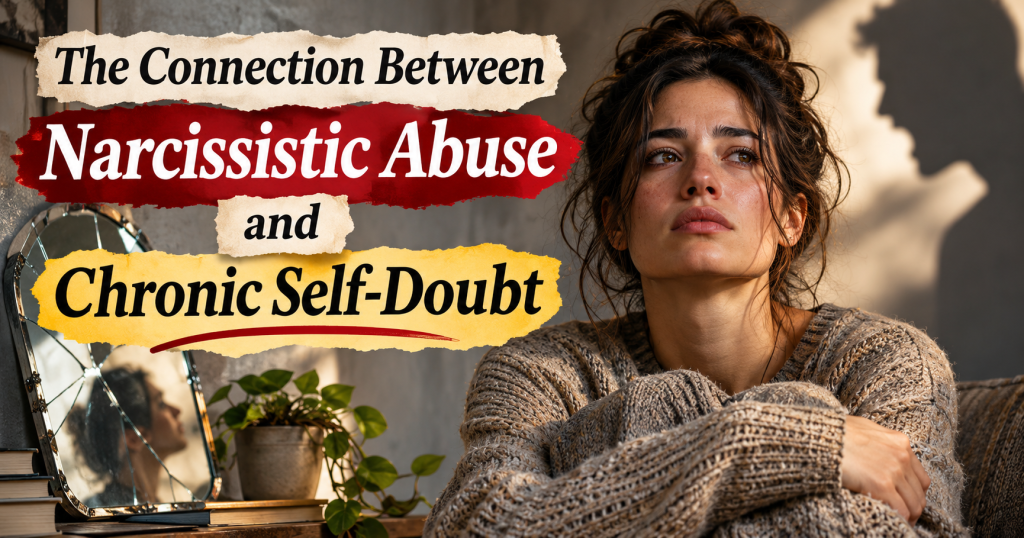
Understanding the connection between narcissistic abuse and chronic self-doubt is an important step toward recognizing what happened and rebuilding trust in yourself.
Related : What Happens Psychologically When You Stop Chasing Someone?
1. How Narcissistic Abuse Creates Chronic Self-Doubt
Narcissistic abuse often involves patterns of emotional manipulation that gradually undermine another person’s confidence.
In the beginning, you may feel valued, understood, and appreciated. But as the relationship develops, the dynamic can change.
Your feelings may suddenly become a problem. Your concerns might be dismissed, your memories questioned, and your reactions criticized.
For example, imagine telling your partner that something they said hurt your feelings. Instead of acknowledging your emotions, they respond:
“You’re always making things complicated.”
“You’re too sensitive.”
“That never happened. You’re imagining things.”
At first, you might defend yourself. But when similar situations happen repeatedly, something begins to change.
You stop focusing on what the other person did and start questioning whether your reaction was justified.
Eventually, you may begin doubting yourself before even expressing an opinion.
This is how repeated emotional manipulation can gradually damage a person’s confidence in their own perceptions.
2. Gaslighting Makes You Question Your Own Reality
Gaslighting is one of the most recognizable manipulation patterns associated with emotionally abusive relationships.
It involves behavior that causes someone to question their memories, perceptions, or understanding of events.
A person might deny something they clearly said, rewrite the history of an argument, or insist that your emotional reaction proves something is wrong with you.
Imagine remembering a conversation perfectly, only to hear:
“That’s not what I said.”
“You’re remembering everything incorrectly.”
“You’re making things up again.”
When this happens occasionally, you might simply disagree. But when it becomes a repeated pattern, you may begin questioning your own memory.
You might start relying on the other person’s version of events because you no longer feel confident in your own.
The most painful part is that this uncertainty can continue even after the relationship ends.
You may still find yourself wondering whether your memories are accurate or whether you somehow misunderstood everything.
Healing involves learning that another person’s denial does not automatically make your experience invalid.
3. Constant Criticism Slowly Destroys Your Confidence
Not all emotional manipulation involves obvious arguments or dramatic confrontations.
Sometimes, it happens through small comments repeated over months or years.
Your appearance, intelligence, decisions, personality, career, or even the way you communicate may become targets of criticism.
You might hear things like:
- “You never do anything right.”
- “Nobody else would put up with you.”
- “You always make stupid decisions.”
- “Why can’t you be more like other people?”
- “You wouldn’t survive without me.”
Individually, these comments might appear insignificant to someone outside the relationship.
But repeated criticism can gradually influence how you see yourself.
You begin questioning your abilities, avoiding decisions, and feeling nervous about making mistakes.
Eventually, you may internalize the criticism and start speaking to yourself in the same negative way the other person once spoke to you.
That’s an important part of the damage: even when the other person is no longer around, their criticism can continue influencing your inner dialogue.
4. You Start Apologizing Even When You Did Nothing Wrong
Have you noticed yourself apologizing simply because someone seems upset?
Perhaps you say sorry when asking a reasonable question, expressing a personal preference, or explaining why something hurt you.
This behavior can develop after spending a long time in an emotionally unpredictable relationship.
When expressing disagreement repeatedly leads to arguments, silent treatment, blame, or emotional withdrawal, apologizing can become a way to avoid conflict.
You might start believing that keeping the other person happy is more important than expressing what you genuinely feel.
Over time, this can turn into an automatic response.
You apologize for having boundaries. You apologize for needing space. You apologize for saying no.
But having feelings, needs, and personal boundaries does not make you a difficult person.
You don’t have to accept responsibility for every uncomfortable emotion someone else experiences.
Related : The Psychology of Why Someone Suddenly Loses Interest
5. You Become Afraid of Making the Wrong Decision
One of the less obvious effects of chronic self-doubt is decision paralysis.
Simple decisions that once required little thought can suddenly feel overwhelming.
You might spend hours deciding what to wear, whether to send a message, or whether to express an opinion.
Why?
Because repeated criticism and manipulation can teach you that making the wrong decision comes with emotional consequences.
You may have become accustomed to having your choices questioned, criticized, or used against you.
As a result, you start looking for reassurance before doing almost anything.
You ask friends what they think. You replay possible outcomes. You imagine how someone might react.
Eventually, even trusting your own preferences becomes difficult.
Rebuilding confidence means accepting that making imperfect decisions is part of being human. You don’t need to guarantee every outcome before allowing yourself to choose.
6. You Constantly Replay Conversations in Your Head
Another common experience after emotionally abusive relationships is excessive overthinking.
You might spend hours analyzing something that happened days ago.
You replay conversations and ask yourself:
“Should I have said something different?”
“Did I sound disrespectful?”
“Was I actually being unreasonable?”
“Did I misunderstand their intentions?”
This mental repetition can become exhausting.
Sometimes, your mind is trying to make sense of experiences that felt confusing, contradictory, or emotionally unsafe.
You may be searching for the explanation that finally makes everything fit together.
But repeatedly analyzing every interaction doesn’t necessarily bring clarity. Sometimes, it keeps you emotionally connected to the same painful experiences.
Instead of trying to solve every past conversation, begin asking yourself a different question:
“What do I know about how this relationship made me feel, and what do I need to feel safe moving forward?”
You don’t have to understand every detail of another person’s behavior to acknowledge that a relationship was unhealthy for you.
7. You Stop Trusting Your Own Intuition
Before the relationship, perhaps you were comfortable recognizing when something didn’t feel right.
You trusted your instincts, made decisions independently, and felt reasonably confident about your understanding of people.
But after repeated manipulation, you may begin questioning those instincts.
Even when someone’s behavior makes you uncomfortable, you might immediately look for excuses.
“Maybe I’m overreacting.”
“Perhaps they didn’t mean it.”
“Maybe I’m being unfair.”
This doesn’t mean your intuition is always correct. Everyone can misunderstand situations.
However, constantly dismissing your discomfort because someone else tells you that your feelings are wrong can disconnect you from your own needs.
A healthier approach is to treat your feelings as information worth exploring rather than evidence that you are automatically wrong.
You can acknowledge discomfort, examine the situation, and decide what boundaries are appropriate without judging yourself.
8. You Feel Like You Have Lost Your Identity
Long-term emotionally abusive relationships can affect more than confidence. They can also interfere with your sense of identity.
You might notice that you no longer enjoy activities you once loved.
Perhaps you stopped seeing certain friends, expressing your opinions, pursuing personal goals, or making independent plans.
Little by little, your attention became focused on managing the relationship and avoiding conflict.
You may have spent so much time trying to understand the other person’s emotions that you stopped paying attention to your own.
After leaving the relationship, you might find yourself wondering:
“Who am I without this person?”
“What do I actually enjoy?”
“What do I want from life?”
These questions can feel uncomfortable, but they can also mark the beginning of rediscovering yourself.
Your identity was never supposed to revolve around keeping someone else satisfied.
9. Why Self-Doubt Can Continue After Narcissistic Abuse Ends
Many survivors expect that leaving an unhealthy relationship will immediately bring relief.
While leaving can create an opportunity for safety and recovery, emotional consequences don’t necessarily disappear at the same time.
You may still experience:
- Difficulty trusting new people.
- Fear of being misunderstood.
- Excessive apologizing.
- Anxiety when expressing disagreement.
- Constantly seeking reassurance.
- Feeling guilty about setting boundaries.
- Questioning whether your previous relationship was really abusive.
This can be especially confusing when you are no longer in contact with the person who caused the distress.
However, emotional patterns developed over a long period may take time to change.
Your mind may still respond to ordinary disagreements as though they carry the same emotional risks you experienced in the past.
This doesn’t mean you are permanently damaged.
It means that rebuilding emotional security and self-trust deserves patience, consistency, and support.
10. How to Rebuild Self-Trust After Narcissistic Abuse
Recovering from chronic self-doubt isn’t about becoming a completely different person.
It’s about reconnecting with the person you were before you started questioning every thought, feeling, and decision.
Here are some practical ways to begin.
Start Writing Down Your Experiences
Journaling can help you separate what actually happened from what someone told you happened.
When you feel confused about an interaction, write down the facts as you remember them.
Include what was said, how you felt, and what happened afterward.
You don’t need to prove your experience to anyone. The purpose is to become more comfortable acknowledging your own perspective.
Stop Seeking Validation From People Who Repeatedly Invalidate You
Not everyone deserves access to your most vulnerable thoughts.
If someone consistently dismisses your feelings, you don’t have to keep explaining yourself in the hope that they will finally understand.
Seek support from people who listen without automatically judging or dismissing you.
Practice Making Small Decisions Independently
Start with simple choices.
Choose what to eat, what to wear, which activity to enjoy, or how to spend your free time without asking several people for permission.
These small decisions can help rebuild confidence in your judgment.
Remember, you are allowed to make mistakes.
Challenge Your Negative Inner Dialogue
Pay attention to how you speak to yourself.
If you catch yourself thinking, “I’m always wrong,” ask whether that statement is actually true.
Replace harsh generalizations with more balanced thoughts.
For example:
Instead of “I can’t trust myself,” try “I’m learning to trust my judgment again.”
Instead of “Everything is my fault,” try “I can take responsibility for my actions without accepting blame for everything.”
The goal isn’t forced positivity. It’s learning to treat yourself fairly.
Establish Healthy Boundaries
Boundaries help you protect your emotional well-being and recognize that your needs matter.
You can say no without writing a long explanation.
You can disagree without turning the conversation into an argument.
You can walk away from interactions that repeatedly leave you feeling disrespected.
Healthy relationships should allow room for different opinions, emotions, and personal choices.
Consider Professional Support
A qualified mental health professional can help you process emotionally abusive experiences and work through persistent self-doubt.
Therapeutic approaches such as cognitive behavioral therapy (CBT) may help you recognize unhelpful thought patterns and develop healthier ways of responding to them.
You don’t need to wait until your struggles become unbearable before asking for help.
11. Learning to Trust Yourself Again Is Part of Healing
One of the most important things to understand about recovering from narcissistic abuse is that you don’t have to spend the rest of your life questioning yourself.
You are allowed to have opinions.
You are allowed to remember things differently from someone else.
You are allowed to change your mind, make mistakes, and establish boundaries.
Most importantly, you are allowed to trust your ability to make decisions without constantly needing someone else’s approval.
Healing doesn’t mean you will never experience doubt again. Self-doubt is a normal part of being human.
The difference is that it no longer has to control your choices or determine your worth.
You can learn to recognize unhealthy patterns, listen to your emotions, and make decisions that reflect your own values.
And perhaps the most meaningful part of recovery is realizing that you don’t need someone else’s permission to believe in yourself.
Final Thoughts
Narcissistic abuse and chronic self-doubt can become deeply connected when a person spends a long time experiencing manipulation, criticism, emotional invalidation, and blame.
Eventually, the repeated questioning of your feelings and perceptions can become something you do to yourself.
But those patterns can change.
You can learn to trust your memory, respect your emotions, make independent decisions, and establish boundaries without feeling guilty.
Don’t rush the process or expect yourself to recover overnight.
You spent time learning to doubt yourself. Give yourself time to learn how to trust yourself again.
You don’t have to keep questioning your worth just because someone once made you feel like you weren’t enough.