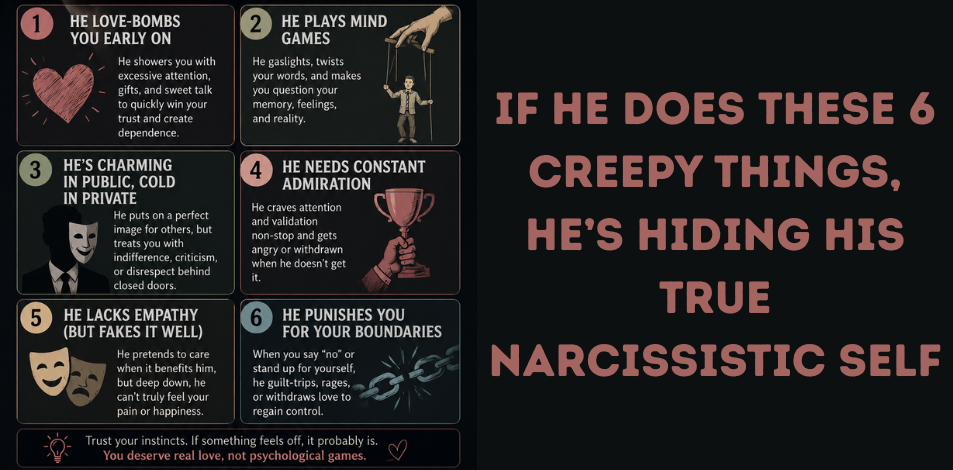
Narcissists rarely reveal their true nature immediately. At first, they may seem charming, caring, and even irresistible. But behind this facade lies a manipulative personality that seeks control, admiration, and emotional dominance. If you feel uncomfortable around him but can’t quite put your finger on why, it could be because he’s hiding his true narcissistic nature.
Here are six suspicious behaviors that could be warning signs he’s not the person he’s pretending to be.
- He showers you with love, then disappears.
Initially, he showers you with compliments, gifts, and intense affection. He makes you feel like you’ve found your soulmate. But just as you begin to trust him, he suddenly withdraws without warning. This fickle behavior is a classic manipulative tactic known as “love bombing.”
Love bombing is designed to disarm you. Narcissists use this tactic to quickly build a romantic relationship, then pull away once you’re emotionally attached to them. It’s a game of control. He draws you in, then pulls away to watch you chase after that relationship you thought was real.
- He’s always watching you… even when you’re apart.
Does he suddenly remember details of your day that you didn’t mention? Or does he seem to know where you are, what you’re doing, and who you’re with—without even asking?
Related : 15 Quotes Every Survivor of Narcissistic Abuse Needs to Read
A narcissist craves control, and intrusive surveillance is one of his ways of monitoring you. Whether he’s compulsively checking your social media accounts, going through your phone, or even tracking your location, his behavior doesn’t stem from love, but from control and pathological suspicion.
This isn’t romance; it’s control. Your privacy is important. If he violates it, you’re dealing with someone who doesn’t respect boundaries.
- He mimics you uncomfortably.
At first, it might seem like you’ve found someone who understands you perfectly. He likes the same music, shares your opinions, and even mimics your movements. It’s almost unsettling how much his personality mirrors yours.
This is called mimicry—a technique narcissists use to gain your trust and quickly form an emotional bond. By becoming everything you want, he makes it easy for you to let your guard down.
The suspicion begins when you realize that nothing about him seems genuine. His personality changes depending on who he’s with. It’s like he’s wearing a mask—and you never know who’s hiding underneath.
- He uses psychological manipulation to make you doubt reality.
Have you ever confronted him about something, only to have him distort the facts, deny what he said, or make you feel like you’re crazy?
This is psychological manipulation—one of the most dangerous tools a narcissist uses. He will coldly lie to you, rewrite history, and manipulate situations to make you doubt your memory, your judgment, and even your sanity.
Examples of manipulative phrases:
“You’re overreacting.”
“This never happened.”
“You’re imagining things.”
“You’re too sensitive.”
If you constantly doubt yourself or feel confused after talking to him, he may be deliberately distorting reality to maintain control.
- He’s obsessed with how others see him (not how he treats you).
Narcissists live for external validation. He may seem attractive, popular, and well-liked by others, but behind closed doors, he is indifferent, cold, or even harsh with you.
He carefully cultivates a positive image in the eyes of the world, while neglecting or manipulating those closest to him emotionally. It’s all about appearances. As long as he seems like the perfect partner to others, he doesn’t feel the need to be that way in reality.
Warning sign: If everyone else sees him as wonderful, while you feel exhausted, hurt, or neglected, trust your instincts. You’re seeing the truth.
- He always plays the victim.
No matter what happens, he’s never blamed. He twists every situation to portray himself as the victim, even when he’s clearly at fault. This isn’t just annoying; it’s manipulative.
If you confront him about something hurtful, he might say:
“I can’t believe you think I would do that to you.”
“After everything I’ve done for you?”
“You always make me feel guilty.”
This tactic shifts the focus from his behavior to your “unfair” treatment of him. Over time, you might start questioning your own feelings and apologizing for his mistakes.
Conclusion: Trust your instincts.
These suspicious behaviors aren’t just whims or misunderstandings; they’re often signs of deep-seated narcissism and emotional manipulation. A healthy partner won’t make you feel watched, confused, or emotionally drained. If your instincts are warning you that something is wrong, don’t ignore them.