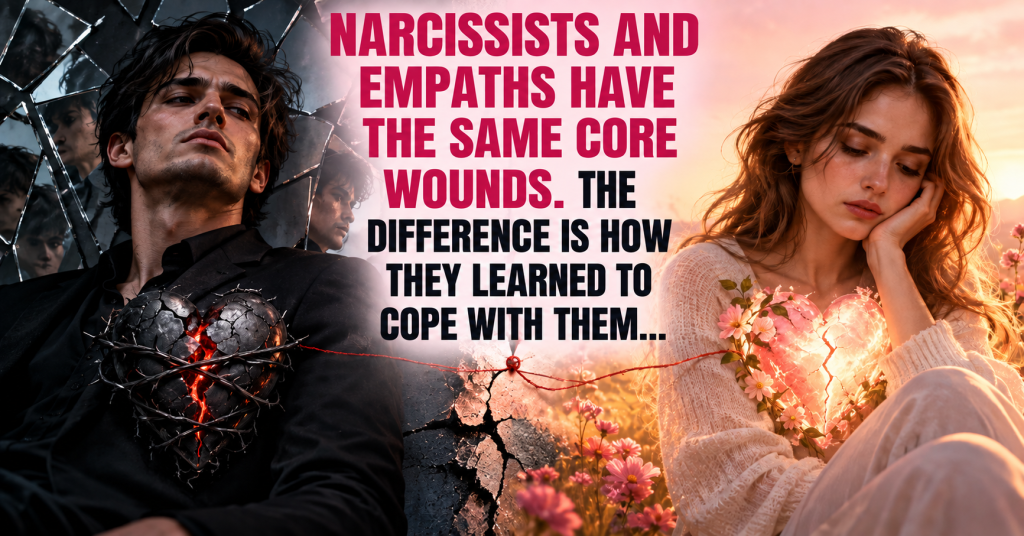
There is a strange pattern that often appears in toxic relationships: narcissists and empaths can seem completely opposite, yet somehow they end up drawn to each other.
One person feels everything deeply. The other may appear emotionally distant, controlling, or intensely focused on themselves. One wants connection and understanding, while the other may seek admiration, validation, or control.
So why can the connection feel so powerful?
A popular idea is that narcissists and empaths have the same core wounds, but learned completely different ways of coping with them. While this isn’t true for every narcissist or every empath, there is an important psychological idea behind it: painful experiences can shape people in very different ways.
Related : Quiet Abuse: The Things Narcissists Do That No One Else Sees
The Wounds Can Look Similar, But the Coping Is Different
People who experience emotional neglect, rejection, criticism, instability, or a lack of emotional safety may develop different protective strategies.
An empathic person may respond by becoming highly sensitive to other people’s emotions.
They might think:
- “I need to keep everyone happy.”
- “I don’t want anyone to feel hurt.”
- “Maybe I can fix this.”
- “I need to understand why they’re acting this way.”
- “If I become more loving, things will get better.”
Someone with strong narcissistic defenses may respond very differently.
They may learn to protect themselves through control, superiority, emotional distancing, defensiveness, or an intense need for external validation.
The underlying emotional insecurity can sometimes overlap, but the behaviors and coping mechanisms are not the same.
Why Empaths Often Attract Narcissistic People
Empaths are often described as compassionate, patient, understanding, and willing to give people second chances.
Those qualities can be beautiful in a healthy relationship.
But in an unhealthy relationship, they can also become vulnerabilities.
An empath may tolerate behavior that should have been a dealbreaker because they are constantly trying to understand the other person’s pain.
They may think:
“They’re acting this way because they’ve been hurt.”
And sometimes that may be true.
But understanding someone’s wounds doesn’t mean you have to accept their harmful behavior.
Compassion without boundaries can eventually become self-abandonment.
Related : When a Narcissist Feels Uncomfortable: What They Do
Why the Relationship Can Feel So Intense
Relationships involving narcissistic traits and highly empathic people can sometimes feel unusually intense.
There may be periods of extreme closeness followed by distance, conflict, rejection, or emotional withdrawal.
This unpredictability can create a powerful emotional cycle.
When affection returns after a painful period, the relief can feel enormous. The person may become focused on getting back to the “good version” of the relationship.
That’s one reason people can find it incredibly difficult to walk away from unhealthy relationships.
They aren’t necessarily holding onto the relationship as it currently exists.
Sometimes they’re holding onto the hope of what it could become.
The Empath Can Start Losing Themselves
One of the biggest dangers is gradually becoming more focused on the other person’s emotions than your own.
You start asking:
“Why are they angry?”
“What did I do wrong?”
“How can I make them happy?”
“Maybe I should apologize.”
“Maybe I’m being too sensitive.”
Eventually, your own feelings become secondary.
You may spend so much energy managing someone else’s reactions that you stop asking an important question:
“Is this relationship actually good for me?”
Healthy relationships don’t require you to constantly monitor another person’s mood to feel safe.
You Can’t Heal Someone by Loving Them Harder
This is one of the hardest lessons for deeply compassionate people.
You can understand someone’s childhood.
You can recognize their insecurities.
You can empathize with their pain.
You can forgive them.
But none of those things guarantee that they will change.
Understanding the reason behind someone’s behavior doesn’t remove the consequences of that behavior.
Real change requires the person themselves to recognize the problem and take responsibility for it.
You cannot do that work for them.
The Difference Is Often in the Coping Strategy
The idea that narcissists and empaths have “the same wounds” should not be treated as a universal psychological fact.
People develop narcissistic traits and empathic behaviors for many different reasons, and not everyone with narcissistic traits has experienced the same childhood or trauma.
But one useful way to understand the dynamic is this:
Two people can experience emotional pain and develop completely different defenses.
One might become hyper-aware of everyone else’s emotions.
Another might become extremely protective of their own ego.
One might seek approval by giving too much.
Another might seek validation by demanding attention.
The wound isn’t necessarily identical.
The adaptation is what makes the difference.
Healing Means Breaking the Pattern
For an empath, healing isn’t about becoming cold or losing compassion.
It’s about learning that compassion must include yourself.
You can say no.
You can leave.
You can stop explaining yourself.
You can stop trying to rescue someone who refuses to take responsibility.
You can care about someone and still decide that their behavior is unacceptable in your life.
That’s not selfish.
That’s a boundary.
Final Thought
Sometimes the strongest connection isn’t necessarily the healthiest one.
A relationship can feel incredibly deep, intense, and emotionally significant while still being damaging.
If you’ve spent years trying to understand someone else’s wounds, perhaps it’s time to understand your own.
You don’t have to stop being an empath. You just have to stop abandoning yourself to prove that you care.