Have you ever tried to explain to someone how their behavior hurt you, only to hear a completely different version of what happened?
First, they say it never happened. Then, if you prove that it did, suddenly it “wasn’t that bad.” If you explain why it hurt you, they tell you that you’re overreacting. And eventually, somehow, the entire situation becomes your fault.
This pattern is often seen in relationships where someone consistently avoids accountability. It can be especially confusing when dealing with narcissistic traits or narcissistic abuse, because the conversation may keep changing until the person no longer has to take responsibility.
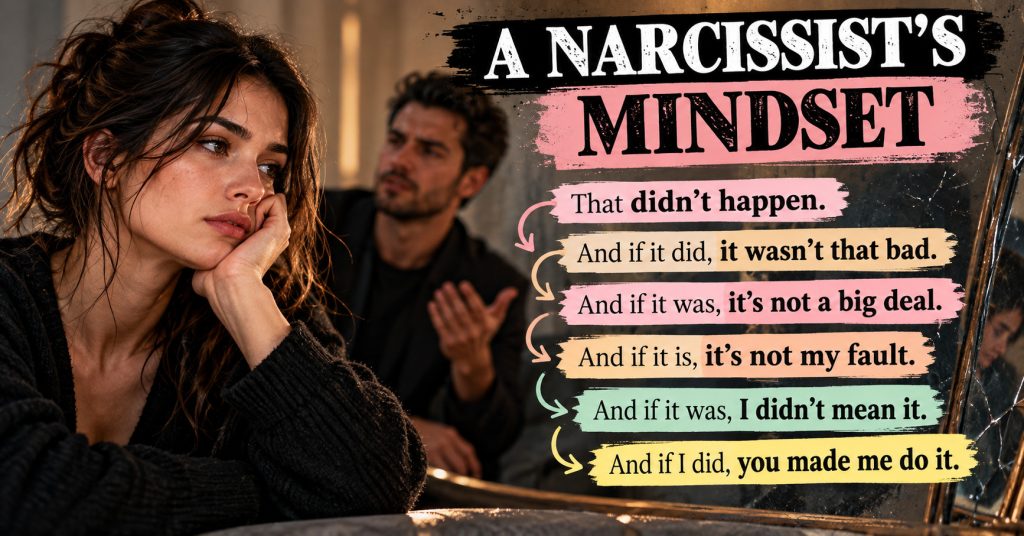
The quote in the image captures this progression perfectly:
“That didn’t happen. And if it did, it wasn’t that bad. And if it was, it’s not a big deal. And if it is, it’s not my fault. And if it was, I didn’t mean it. And if I did, you made me do it.”
While not every person who behaves this way has narcissistic personality disorder, the pattern itself is worth understanding.
1. “That didn’t happen.”
The first response can be outright denial.
You remember what was said. You remember what happened. But the other person insists that your version is completely wrong.
This can leave you questioning your own memory, especially when the denial happens repeatedly.
In unhealthy relationships, constant denial can make meaningful communication almost impossible because you cannot resolve an event if the other person refuses to acknowledge that it occurred.
Related : 6 Small Boundaries With a Narcissist That Protect Your Peace
2. “It wasn’t that bad.”
When denial no longer works, the next step may be minimization.
Instead of denying the behavior, the person reduces its importance.
Maybe they insulted you, but “they were only joking.”
Maybe they disappeared for days, but “you’re making a big deal out of nothing.”
Maybe they broke a promise, but “everyone makes mistakes.”
The focus shifts away from what happened and toward whether you are “allowed” to feel hurt by it.
3. “It’s not a big deal.”
This is another form of minimizing your emotional experience.
Something can be small to one person and deeply painful to another. Healthy communication leaves room for both people to discuss that difference.
But when someone repeatedly dismisses your feelings, you may eventually stop trusting your own emotional reactions.
You start thinking:
“Maybe I am too sensitive.”
“Maybe I really am overreacting.”
“Maybe I should just let it go.”
That self-doubt can become exhausting.
4. “It’s not my fault.”
When the behavior can no longer be denied or minimized, responsibility may be pushed somewhere else.
Suddenly, the conversation becomes about your behavior.
“You made me angry.”
“You pushed me too far.”
“You know how I am.”
“If you hadn’t done that, I wouldn’t have reacted.”
This is blame shifting: instead of taking responsibility for their own actions, the person presents your behavior as the reason they acted the way they did.
There is an important difference between explaining someone’s behavior and excusing it.
Someone can be angry, hurt, jealous, or frustrated without being entitled to mistreat another person.
Related : 7 Ways to Protect Yourself From Toxic and Narcissistic People
5. “I didn’t mean it.”
Sometimes the defense changes again.
Now the behavior is acknowledged, but the intention becomes the focus.
“I didn’t mean to hurt you.”
“I was just joking.”
“You misunderstood me.”
Intentions matter, but they don’t automatically erase consequences.
A person can genuinely have had a different intention and still recognize that their words or actions caused harm.
Healthy accountability sounds more like:
“I didn’t intend to hurt you, but I understand why it hurt you. I’m sorry, and I’ll try not to repeat it.”
That response creates space for repair rather than another argument.
6. “You made me do it.”
This is where responsibility can completely reverse.
The person is no longer defending what they did. Instead, they are making you responsible for their reaction.
This can be particularly damaging in toxic relationships because you may begin believing that you have to control your words, emotions, movements, friendships, or boundaries just to prevent the other person from behaving badly.
But adults are responsible for their own choices.
Someone else’s behavior can influence your emotions, but it does not remove your responsibility for how you choose to respond.
Related : Why Narcissists Target Kind-Hearted People
The Pattern Behind It
The important part isn’t necessarily one sentence.
It’s the cycle:
Denial → Minimization → Dismissal → Blame Shifting → Excuses → Reversal of Responsibility
When this happens repeatedly, conversations can become circular.
You bring up the original issue.
They deny it.
You provide evidence.
They minimize it.
You explain why it hurt.
They blame you.
You ask for accountability.
They explain why you caused their behavior.
And suddenly, you’re defending yourself instead of discussing what originally happened.
How to Respond to This Pattern
You don’t always need to convince someone to agree with your version of reality.
Sometimes the healthiest response is to stop debating every detail and focus on your own boundaries.
You can say:
“We remember the situation differently, but I’m not comfortable with how I was treated.”
Or:
“You may not agree with my feelings, but you don’t get to decide whether I’m allowed to have them.”
And sometimes, the most important question isn’t:
“How can I make them understand?”
It’s:
“What am I going to do if this behavior continues?”
That shift can help you move from trying to control another person’s reaction toward protecting your own emotional boundaries.
Final Thoughts
Not every disagreement, defensive reaction, or failure to apologize means someone is a narcissist. People can become defensive for many reasons.
What matters is the repeated pattern.
If someone consistently denies obvious events, minimizes your feelings, shifts blame, refuses accountability, and makes you responsible for their behavior, the relationship can become emotionally exhausting.
You don’t need someone else to validate every detail of your experience before you are allowed to recognize that something hurt you.
Healthy relationships don’t require you to constantly prove that your feelings are legitimate.