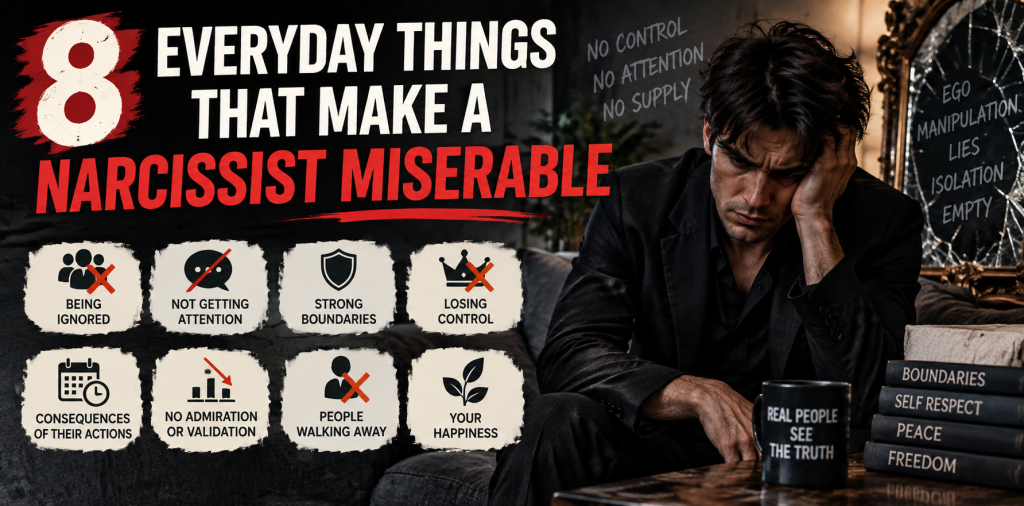
Narcissism is not merely about vanity or arrogance; at its core, it reflects a fragile sense of self that requires constant validation from others to remain intact. Consequently, ordinary, simple situations, which most people would overlook without a second thought, can feel like genuine threats to those with strong narcissistic traits.
Understanding what triggers this distress is not about seeking revenge; rather, it is about recognizing behavioral patterns. This awareness allows you to protect your own peace of mind, establish better boundaries, and stop taking others’ reactions personally. Here are eight everyday situations that often provoke hypersensitivity in such individuals, along with the underlying psychological reasons:
Related : 12 Moments That Show The Narcissistic Abuse Was Intentional
- Being Ignored or Met with Indifference
For those with narcissistic tendencies, attention acts as “emotional oxygen.” When they enter a room and elicit no reaction, or when a conversation continues without acknowledging them, they may experience distress and anxiety far out of proportion to the situation. This goes beyond ordinary insecurity; it stems from a deep reliance on external validation to regulate their sense of self-worth. Being treated like an ordinary person clashes with their internal conviction that they are exceptional, and the resulting gap between reality and their self-perception creates profound discomfort.
- Losing Control of a Situation
Control provides a sense of security and predictability; for this very reason, losing it is deeply unsettling for a narcissist. Unexpected changes, decisions made without their input, or plans that shift abruptly can trigger intense frustration in them. The issue is rarely the practical inconvenience itself, but rather what the loss of control signifies: a reminder that they are not the ones steering the ship or dictating the course of events.
- Lack of recognition for their work
Making a contribution without receiving recognition is a hidden source of unhappiness for many narcissists. If a team effort succeeds and someone else receives the praise, or if credit is shared rather than attributed solely to them, they may view this as an erasure of their existence and role, rather than as a collaborative endeavor. True collaboration requires accepting the concept of shared success, which conflicts with their need to be seen as the sole architects of positive outcomes.
- Facing criticism, however gentle
Accepting constructive feedback can be difficult for most people, but for those with narcissistic traits, criticism may be perceived as an attack on their entire identity, not merely a comment on a specific behavior or aspect of their work. This exaggerated reaction is sometimes termed a “narcissistic injury”; it is a blow to their self-image that provokes defensive reactions, denial, or even anger, regardless of how gently the feedback or criticism was delivered. 5. Seeing someone else steal the spotlight
Whether it involves a friend’s promotion, a sibling’s engagement, or a colleague winning an award, hearing good news about someone else can be difficult for a narcissist to accept or tolerate, especially when it happens within their immediate circle. Instead of sharing in others’ joy, such situations may trigger feelings of comparison and suppressed resentment; this is because another person taking center stage, even briefly, is perceived as a personal affront to the narcissist’s own status.
- Hearing the word “no”
A direct refusal, whether regarding a request, a favor, or an opinion, may be taken very personally by a narcissist, far beyond the actual intent behind the rejection. Since their self-image often hinges on being persuasive, important, or someone whose requests cannot be denied, setting boundaries or saying “no” to them may be interpreted as a sign of disrespect, rather than a natural part of any relationship.
- Being Treated Like an Ordinary Person
Casual conversations that do not celebrate their achievements, discussions that do not center on them, or even simply being treated like everyone else can trigger a strange sense of threat. Their underlying, and often unconscious, belief is that they are fundamentally different from “ordinary” people; consequently, being treated as such can feel like an unfair slight.
- Facing Real Consequences for Their Actions
Accountability is one of the most difficult daily challenges for those with strong narcissistic traits, as it requires admitting fault, something that seems to contradict the idealized self-image they cultivate. Consequences (such as a warning at work, a friend distancing themselves, or a partner setting firm boundaries) often provoke reactions characterized by blaming others, downplaying the situation, or anger, rather than self-reflection or introspection.
What Does This Mean for You?
The points above do not constitute a medical diagnostic checklist; narcissistic traits exist on a spectrum, and only a licensed professional can diagnose personality disorders. However, if you observe this pattern in someone close to you, the greatest benefit lies not in knowing how to trigger these reactions, but in the exact opposite: understanding these behaviors can help you stop over-explaining and over-justifying, cease accepting blame that isn’t yours, and maintain clear boundaries with less guilt.