
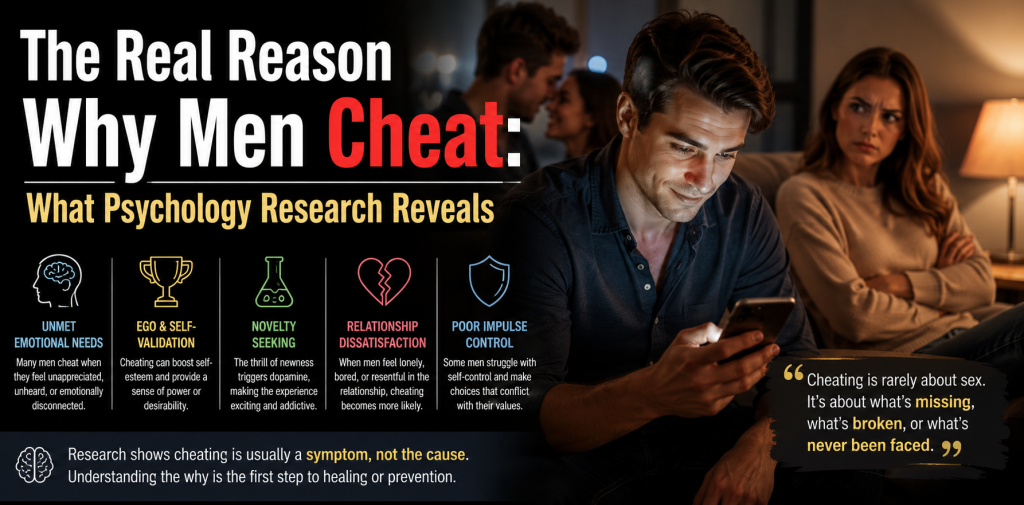
Type “why do men cheat” into a search bar and you’ll get a hundred confident, contradictory answers: it’s biology, it’s boredom, it’s a bad marriage, it’s just what men do. The truth is less tidy , and more useful. There isn’t one real reason men cheat. Researchers who’ve actually studied infidelity, rather than speculated about it, consistently find a cluster of overlapping motives, and which one applies depends heavily on the person and the relationship.
This article walks through what peer-reviewed research and relationship psychologists actually say, without the stereotypes that usually dominate this topic.
Key Takeaways
- Infidelity researchers have identified around eight distinct motivations for cheating , not one “male psychology.”
- Men are statistically more likely to cite sexual variety, opportunity, and low relationship satisfaction; women more often cite emotional neglect , but the overlap between the sexes is large.
- Roughly 1 in 5 married men report having cheated at some point, according to long-running General Social Survey data , a rate that has actually declined since the 1990s.
- Biological factors like testosterone are correlated with infidelity risk, but researchers are careful to note this explains a tendency, not an excuse.
- Most affairs are less about a single dramatic reason and more about a slow accumulation of unmet needs, opportunity, and poor decision-making under pressure.
How Common Is Male Infidelity, Really?
Before getting into motive, it helps to have accurate numbers, because pop culture tends to exaggerate them.
Long-term data from the General Social Survey, analyzed by researchers at the Institute for Family Studies, puts lifetime infidelity among ever-married men at around 21% in the 1990s, dropping to about 11% in the early 2020s. Other analyses of the same GSS dataset land closer to 20% of married men and 13% of married women reporting extramarital sex , the exact figure shifts depending on the years and age range analyzed, but the pattern is consistent: men cheat somewhat more often than women, though the gap has been narrowing for decades. Notably, among adults under 30, women now report cheating slightly more often than men do.
Related : The Note That Made Me Leave My Relationship
Two other findings are worth knowing:
- Education and religion both correlate with lower rates. College graduates report cheating less often than those with less education, and people who regularly attend religious services report notably lower rates than those who don’t, according to the same Institute for Family Studies analysis.
- Definitions matter enormously. Surveys that only count physical sex outside the marriage report lower numbers than those that also count emotional affairs or sustained secret relationships , some estimates for combined emotional-and-physical infidelity run well above 40%.
There’s No Single “Real Reason” , Researchers Found Eight
The most rigorous study on this question comes from the University of Maryland, where psychologist Dylan Selterman and colleagues surveyed 562 adults who admitted to being unfaithful while in a committed relationship, then analyzed their answers to identify recurring motivations. The result, published in the Journal of Sex Research, was a set of eight distinct categories: anger, self-esteem or mood regulation, lack of love, low commitment, neglect, situation or circumstance, variety, and sexual desire.
The gender pattern that emerged wasn’t a simple stereotype. Men were more likely to report being driven by sexual desire, a wish for variety, and situational forces, while women more often pointed to neglect — but both groups drew from the same overall menu of reasons, just in different proportions.
The Reasons Men Most Often Cite
1. Relationship Dissatisfaction , Not Just About Sex
It’s tempting to assume men cheat purely for physical variety, but a psychologist-led analysis for Forbes found that the single most commonly endorsed reason men gave wasn’t sex , it was a general sense that something important was missing from the relationship, whether emotional reciprocity, physical intimacy, or a feeling of investment from their partner. When men don’t feel valued, appreciated, or connected, the risk of looking elsewhere rises , the same dynamic that drives female infidelity, just less discussed.
2. Desire for Sexual Variety and Novelty
This is the reason most consistent with existing research: men, on average, report a stronger drive for sexual variety than women do, and researchers describe theoretical grounds for expecting male infidelity to be more “variety-driven.” In interviews, men who cheated for this reason often describe it less as dissatisfaction and more as curiosity or a fear of missing out on other experiences.
3. Attraction to Someone New
Somewhat related: an affair partner being perceived as more physically attractive than a current partner is one of the most commonly cited factors in studies of male infidelity. Researchers frame this through an evolutionary lens , physical attractiveness has historically served as a cue for fertility and health , though they’re careful to note this describes a psychological tendency, not a justification.
4. Situational Opportunity
Cheating often isn’t premeditated. Travel, alcohol, workplace proximity, and , increasingly , dating apps and social media create low-friction moments where a boundary gets crossed almost by accident. Digital platforms in particular have changed the landscape: researchers note that internet-enabled affairs have made commitment and trust noticeably harder to manage in modern relationships, simply because opportunity is now a few taps away.
5. Low Self-Esteem or a Need for Validation
Sociologist Alicia Walker, author of a book specifically on men and infidelity, argues that for many men cheating functions less as a sexual act and more as a psychological one: when a marriage stops affirming a man’s sense of masculinity or self-worth, an outside relationship can become a way of compensating for that. This lines up with broader research linking low self-esteem and an excessive need for outside affirmation to a higher likelihood of infidelity in both sexes.
6. Anger, Revenge, or Resentment
A smaller but real share of affairs are motivated by retaliation , often after discovering a partner’s own betrayal, or after prolonged, unresolved resentment. This was one of the eight categories identified in the University of Maryland research and shows up across nearly every major infidelity study.
7. Falling Out of Love or Low Commitment
Sometimes it’s simpler than any of the above: one partner never fully committed to exclusivity, or the emotional bond quietly faded years before the affair began. Selterman’s research grouped this separately from “neglect,” since it reflects an absence of investment rather than an active grievance.
The Biology Question: Is It Just Testosterone?
Hormonal research adds a real, if limited, piece to the picture. A 2019 study found that men with higher testosterone levels were more likely to have extramarital affairs than men with lower levels, and separate research suggests testosterone tends to drop in men who settle into monogamous, committed relationships , while men who maintain persistently high levels appear more prone to seeking multiple partners.
Related : 7 Dating Rules That Stop Working After 50 (And What Actually Works Instead)
It’s worth being precise about what this does and doesn’t mean. Higher testosterone is associated with a stronger sex drive and, in some studies, lower empathy , a combination that can raise risk. But researchers who study this are explicit that evolutionary and hormonal tendencies are descriptive, not prescriptive , they help explain patterns across large populations; they don’t predict, let alone excuse, any individual’s choices. Most men with high testosterone don’t cheat, and biology is only ever one input among many psychological, relational, and situational factors.
Myths Worth Retiring
- “Only unhappy men cheat.” Plenty of men who describe their relationships as generally happy still cheat, often citing opportunity or variety rather than dissatisfaction.
- “It’s always about sex.” Emotional neglect, validation, and anger show up as motives just as often as physical desire.
- “Cheaters are all the same kind of person.” The eight-motivation framework exists precisely because no single personality type or story fits every case.
- “It’s genetic, so it’s inevitable.” Twin studies do suggest a modest heritable component to infidelity risk, likely tied to personality traits or libido , but heritability describes a statistical tendency across a population, not a fixed fate for any one man.
Can a Relationship Survive Infidelity?
Yes, often. Therapists who specialize in affair recovery report that a majority of couples who commit to structured therapy after infidelity , particularly when the affair is disclosed rather than discovered by accident , go on to stay together, though the process typically takes many months and requires both partners to be genuinely willing to rebuild trust. Infidelity remains one of the most commonly cited factors couples name when a marriage ends, which is part of why understanding its roots , rather than just its aftermath , matters.
FAQ
Do most men who cheat regret it? Regret is common but not universal; it tends to correlate with whether the affair caused visible harm to the relationship or family, and whether the man saw it as reflecting his values.
Is emotional cheating different from physical cheating for men? Research suggests men are somewhat more likely to draw a sharp line between “just sex” and an emotional affair, while women are more likely to see emotional intimacy with someone else as the deeper betrayal , though most people, regardless of gender, consider both forms a violation of trust.
Does having more money or status increase infidelity risk? Some research links higher income and workplace status to increased infidelity risk, largely because they increase both opportunity and perceived options , not because status itself causes cheating.
Can therapy prevent infidelity before it happens? Couples counseling that addresses emotional neglect, resentment, and mismatched needs early is associated with lower infidelity risk, since several of the most common motives , neglect, low commitment, anger , are exactly what proactive therapy targets.
The Bottom Line
There is no single “real reason” men cheat , and treating it as one hides more than it reveals. The research points to a handful of recurring threads: unmet emotional needs, a pull toward novelty, opportunity meeting low restraint, and sometimes a bid for validation or an outlet for anger. Biology tilts the odds slightly but doesn’t write the story. Understanding which thread applies to a specific relationship , rather than reaching for a one-size-fits-all explanation , is usually the more useful place to start, whether the goal is repairing trust or simply making sense of what happened.
This article is for informational purposes and reflects published psychological and sociological research. It isn’t a substitute for guidance from a licensed therapist or counselor, particularly for couples navigating infidelity directly.