The word “narcissist” is overused these days, partly due to our selfie-obsessed world. Social media has given everyone a platform to show off their photos, and the fast-paced culture has turned people into something akin to salad dressing: you can pick a different flavor at any time. Love is offered like any other commodity. We lack patience and detachment. Technology has given us a throne and a rechargeable magic mirror.
But first, let me clarify the difference between narcissistic tendencies and explicit narcissistic personality disorder. Narcissistic personality disorder is diagnosed by a therapist. In the Diagnostic and Statistical Manual of Mental Disorders, Fifth Edition (DSM-5), published by the American Psychiatric Association,[1] narcissistic personality disorder is defined as an endemic pattern of grandiosity (in imagination or behavior), a persistent need for admiration, and a lack of empathy, beginning in early adulthood and continuing to the present.
They call it early adulthood because most teenagers exhibit narcissistic tendencies. This is no joke; it’s a personality disorder in adults, and a person with this disorder must possess at least five of these nine traits.
An exaggerated sense of self-importance
A persistent preoccupation with fantasies of absolute success, power, intelligence, beauty, or perfect love
A belief that they are special and unique, and can only be understood by, or associated with, special or high-status people or institutions
A desperate need for excessive admiration
A sense of entitlement
Exploitative behavior in interpersonal relationships
A lack of empathy
Envy of others or a belief that others envy them
Displaying arrogant and condescending behaviors or attitudes
This doesn’t happen on a weekend when your best friend, who is exhausted, underpaid, and self-loathing, decides to make it her birthday. These are deeply ingrained personality traits. They are embedded in their character, their behavior, and how they interact with the world and their relationships.
Related : Hoodwinked by a Narcissist
Okay, let’s get out of the atmosphere of psychotherapy sessions and address the issue from the perspective of everyday life.
Why are we attracted to narcissists in the first place? Well, because they possess a certain charisma. And because they constantly crave attention, they’ve honed their charisma and developed a certain appeal. They’ve refined their charisma, which you mistake for self-confidence. The satisfaction you feel in yourself, in your own right, when you attract the attention of the person who commands all the attention, makes you feel better about yourself. You don’t realize it. It all happens in the shadows. Until you realize it’s not confidence, it’s insecurity. They’re putting on an act to prove their worth, not because they’re clever or charming, but because they’re afraid of being ordinary. But by then, you’ve already lived with them, and the eggshells have cut you.
“When I look at narcissism from the perspective of vulnerability, I see the fear born of shame at being ordinary. I see the fear of never feeling special enough to be noticed, loved, belonged, or find purpose in life.” —Brenn Brown
You don’t need to have a clinical diagnosis of narcissistic personality disorder for your partner to become abusive. Simply being with someone who has narcissistic tendencies can lead to abuse. This is something most of us experience. Yes, there’s a wide spectrum of narcissistic behaviors, from the average person to someone who overreacts. But excessive use of the first-person pronoun, character assassination, and a lack of accountability can all leave you feeling inadequate and inferior.
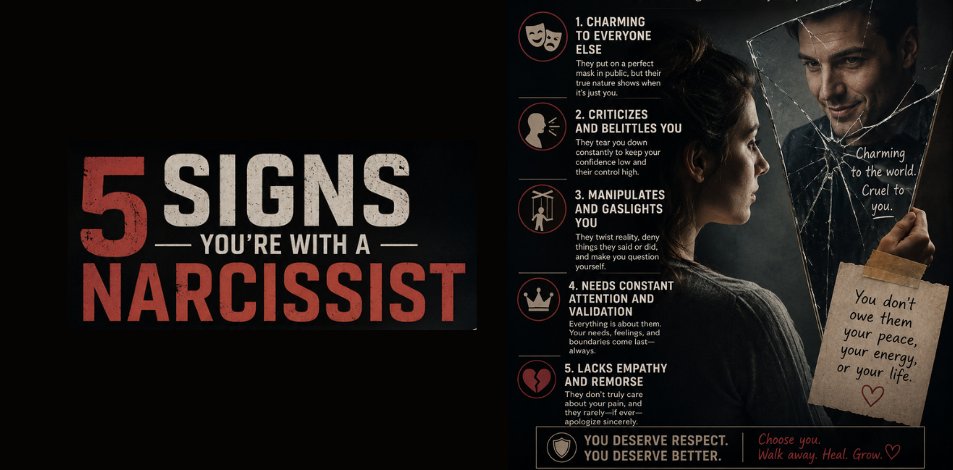
Here are five narcissistic tendencies to watch out for that may indicate an abusive relationship. These tendencies need to be consistent, not just a fleeting occurrence or something that happens when you’re feeling frustrated or self-conscious, because we all have narcissistic tendencies at times.
- They don’t listen to you
They may seem to be listening, but in reality, they’re only hearing themselves as they quickly prepare their responses. They aren’t listening to what you’re saying because they lack empathy. Without empathy, no one feels heard or understood. Their focus is on being understood rather than trying to understand others. Talking to a narcissist is like driving down a one-way street without realizing it, then wondering why no one else is coming.
- They don’t accept criticism.
Remember, they are perfect. Or at least that’s how they want the world to see them. Criticism means they’re not perfect, and that’s not something they’re willing to let go of. It doesn’t matter how much they say they love you; they love themselves more. If they let go of criticism and accepted it, their fragile ego (their sense of self) would crumble.
- The rules don’t apply to them.
They think they’re special. Smarter, more attractive, more fun, everything. Rules are for ordinary people. If they follow them, they’ll become ordinary too. So they’re above the rules. Well, the truth is, all healthy relationships have rules. That’s what makes a relationship secure. And security is what builds trust. If one person doesn’t believe the rules apply to them, then the relationship is ultimately insecure.
- They never make mistakes.
If they make a mistake, it means they’re your equal or less than you. And that means they’re no longer special. They can’t make mistakes. And since they never make mistakes, the mistake will always be yours. This is where the blame comes in. A lot of it. And self-blame, too. A lot of it. The fewer mistakes they make, the more you believe you’re special. Not because of what you did, but because of who you are.
- They don’t take responsibility.
If they never make mistakes, there’s nothing to take responsibility for. A sense of responsibility comes when we believe we’ve done or said something wrong, and we take responsibility for it. If we believe we never make mistakes, then there’s no need for responsibility. But the danger of not taking responsibility isn’t in the rightness or wrongness itself; it’s that a person who doesn’t take responsibility hinders their own growth and sets limits for themselves. When one person in a relationship stops evolving, conflict arises.
If you’ve been in an abusive relationship with a narcissist, the first step is to stop blaming yourself. It’s easy to think you made a mistake, or that you should have been wiser in choosing your partner. You weren’t the problem.
This didn’t happen suddenly; it unfolded in stages, like the initial courtship and moments of honesty. The manipulation and deception only surfaced later, when you began to question your own worth. This is what you need to remind yourself of. No matter how much time has passed or how much those questions have faded, they may have driven you to leave, or perhaps you’re still questioning them now. In either case, these questions prove that you believe in your own worth. You matter. You deserve better. Believe in that. And keep nurturing it. It will lead you to a new path of acceptance, forgiveness, and regained self-confidence.
“When a narcissist leaves you, it means they couldn’t break you. No matter how much they abused you, you held your ground, your self-confidence, and your self-worth. You were a mirror to their dysfunction. Consider their departure a compliment.” – Tess Brewer