Upon closer examination, some scapegoats may appear narcissistic, but not in the expected way, and not because they committed any wrongdoing. They are emotional narcissists, trying to maintain some semblance of dignity amidst their familial torment.
Who Is The Scapegoat?
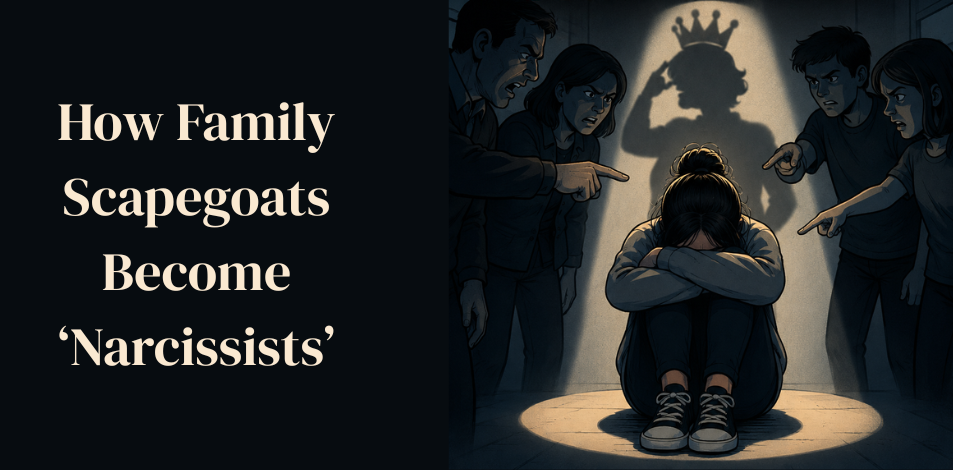
A narcissist’s resentment doesn’t disappear; it’s merely repressed. The narcissist needs someone to unleash their pent-up anger on—a “bad” child in the family. Typically, the narcissist sees the second oldest or most vulnerable child as the troublemaker and targets them with constant rejection and abuse.
While the spoiled child in a narcissistic family is never at fault, the scapegoat is never at fault. The scapegoat is always portrayed negatively, regardless of reality, over and over again, day after day.
The rest of the family, unconsciously, follows the narcissist’s lead, using the scapegoat as an outlet for their own resentment and shame. The scapegoat is often the first to show symptoms of mental illness, a consequence of the heavy burden of being the outlet for their family’s toxic emotions.
Scapegoat’s Reaction to Abuse
As a reaction to constant belittling by their family, the scapegoat may inflate their own ego, using grandeur to escape the debilitating shame that weighs them down. They might boast, launch a counterattack, or simply try to set boundaries or express their distress. The rest of the family reacts in two ways, depending on the situation:
Attack: When the scapegoat takes the opportunity to inflate their ego, boasting about their sense of grandeur to compensate for feelings of inadequacy and worthlessness, the rest of the family mocks and attacks them to “put them in their place.” This often happens at the dinner table or in the living room, when everyone is engaged in conversation and the scapegoat dares to assert themselves.
Provocation: When other family members feel insecure or have excess negative emotions they wish to release, they deliberately provoke the scapegoat by highlighting their weaknesses (created by the narcissistic parent). This forces the scapegoat to overestimate their own worth to deflect the shame resulting from these attacks.
The Bitter Truth About the Narcissistic Family
In a narcissistic family, every member possesses a degree of narcissism, as no one can escape the narcissistic parent’s excessive expectations. Like the flu, narcissism gradually spreads to all family members due to their close bonds. The crucial difference lies in how each individual responds to it.
The neglected child hides their arrogance, as no one truly acknowledges it. The spoiled child displays their narcissism to the narcissistic parent. The young child revels in their perceived greatness through their kindness and charm. The scapegoat expresses their sense of greatness in short, desperate, and utterly unbearable outbursts. The scapegoat suffers humiliating psychological torture and constantly searches for meaning (self-esteem).
Related : The Empath And Narcissist: Breaking The Cycle
The family drama created by a narcissistic parent cannot be ignored. It instills a “narcissistic mindset” in family members, where all that matters is remaining on the “good” and “best” side.
The dichotomy of good and evil becomes a tangible reality. Love, comfort, care, growth, and empathy are all absent. The balance is everything, dominating the entire family experience and stifling any sense of inner peace. As the oppression within the family intensifies, the scapegoat becomes the one who bears everyone’s burden.
The Difficult Scapegoat Strategy
How does the scapegoat escape this exhausting, perpetual hell?
It’s not easy.
But it is possible. First, the scapegoat must acknowledge that the damage is deeply ingrained and will hinder their attempts to recover.
The scapegoat must accept that they will not find salvation in their family home but must move to a new environment. He must relinquish his relentless pursuit of his narcissistic family’s approval.
Above all, he must abandon his sense of grandeur as a defense mechanism and gradually acknowledge his anger at the mistreatment.
By relinquishing his need for his family’s approval and his defense mechanisms, the scapegoat falls into a spiral of pain, fear, and doubt. Alone in the desert of the world, burdened by shame, anger, and trauma, the scapegoat will be tempted to join new groups and situations where he can replay his role out of compulsion. He must constantly be wary of this unconscious process.
The scapegoat must painstakingly forge a new identity and find the courage to abandon his old one. It is possible, of course, that they are not “worthless fools” if they can create this reality. They achieve this by challenging their beliefs about themselves and weaving new experiences that refute the lies of their original families.
Facing The Dark
The scapegoat’s shadow will be his heaviest burden. The positive qualities his narcissistic family rejected remain dormant, drowned in a sea of shame, trauma, and despair. Diving into its depths and reclaiming them will be an incredibly difficult task.
Over time, the scapegoat will realize that his harshest critic wasn’t his narcissistic father or family, but himself. This critical voice will remain with him, tormenting him and attacking everything he does. Exploring and uncovering it will be crucial to his recovery.
The scapegoat will need help. His shadow is more oppressive than others’, and he needs a lifeline to escape its depths, or it may consume him. A therapist, a support group, or even a loving friend can provide this lifeline to varying degrees, offering a gentle nudge to reassure him when he is engulfed by the depths of his shadow.
The Scapegoat
Contrary to his family’s opinion, the scapegoat is a warrior with an indomitable will. He has weathered adversity and remained steadfast. His perseverance is unparalleled, and if steered away from his family’s troubles, he can be guided toward a profound recovery.
Finally, and most importantly, the term “scapegoat” should be written down, hung on the wall, and looked at every day. As one journeys through recovery, navigating countless days of suffering and confusion, a day will come when one feels ready to discard the term and embrace a new way of life, one without labels.
The scapegoat is a complex human being, both terrifying and magnificent, capable of being anything. When the scapegoat realizes this, he should tear the paper off the wall, crumple it up, and throw it in the trash. Never look back.