A narcissistic mother can be a destabilizing and terrifying force in her child’s life. Recovering from her abuse is a delicate process, not only because of her actions but also because of what she represents. Like Mother Nature, a narcissistic mother has the power to nurture or destroy a life like a hurricane that sweeps through her child’s heart.
Signs of a Narcissistic Mother
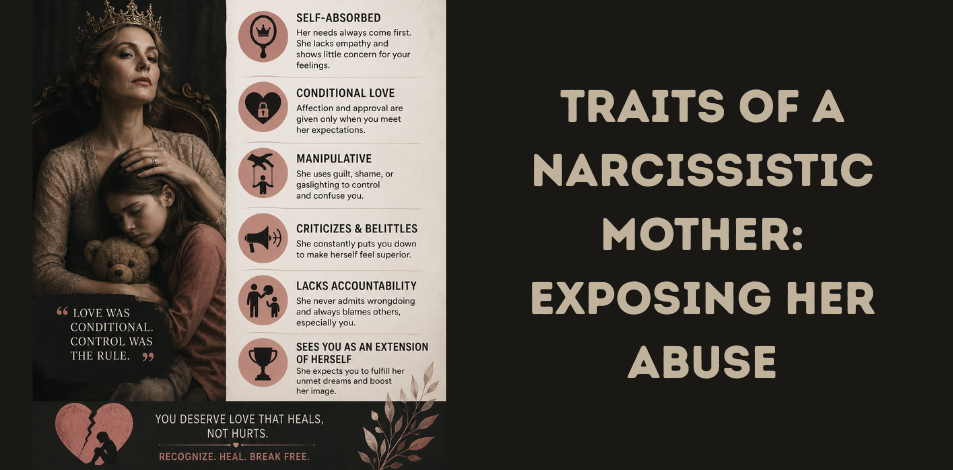
From childhood to adulthood, a narcissistic mother remains a constant shadow in a child’s life, subtly controlling their emotions and manipulating them at will. The first step to recovering from a narcissistic mother is recognizing her superficial behaviors. A narcissistic mother will exhibit some or all of the following traits:
Lack of Empathy
When you share something honest and important to you, a narcissistic mother will try to suppress it as quickly as possible or simply ignore it. She might nod, change the subject, or dismiss your words as childish. This rejection of your honest expression leaves you feeling ashamed and unloved.
Condescending Looks / Eye Rolling
A narcissistic mother can express her displeasure with a condescending look or an eye roll. She may send these signals dozens of times a day as a way to subtly control her child’s behavior.
Over the months and years, her expressions of displeasure undermine her child’s self-confidence and willpower, turning them into a submissive child where those expressions are no longer needed—the child simply does what she expects.
Talk About You in the Third Person
When your narcissistic mother talks about you to someone else in your presence, especially in a displeasing way, you may feel ashamed and helpless. For example, “Lisa is so lazy around the house. She doesn’t do any chores and spends all day watching Netflix.” When this is said to someone else in your presence, it implies that two “more knowledgeable” people are talking about you: you are the center of attention.
Related : How Narcissists Weaponize Their Borderline Core
First, this is a personal statement (perhaps Lisa felt a bit unwell and watched Netflix for two hours to relax), and it forces you to either defend yourself or feel ashamed.
Critical Rhetorical Questions
A narcissistic mother might ask, “Why did you arrange the dishes like that?” or “Why are you wearing that skirt?” These questions have no real answer and no purpose other than to highlight what she perceives as your incompetence or stupidity.
Comparing You to Others
When a narcissistic mother points out that your brother or someone else can do something you can’t, or that they are better than you at something, she forces you to conform to her value system. She will constantly compare you to your siblings to maintain control. She might even complain (personally) to her single daughter that every other woman her age is happily married with children. These subtle comparisons undermine you and make you feel ashamed.
These are just some of the destructive ways a narcissistic mother inflicts psychological harm on her child.
Characteristics of a Narcissistic Mother
Furthermore, a narcissistic mother exhibits the following characteristics in her relationship with her children:
Permanent Dependence
A narcissistic mother desires her children to remain dependent on her, even after they reach adulthood. She treats them like children, instilling doubt in their ability to be independent. She calls them childish names, meticulously manages their lives, and ridicules them, all with the aim of keeping them small enough to be controlled.
Furthermore, a narcissistic mother’s neglect of her child’s need for growth and development suggests to the child that they are incapable of developing personal strength.
Manipulative Communication
To avoid embarrassment, the narcissistic mother expresses her feelings and resentment indirectly, either through her husband, one of her children, or by hinting. This secretive communication allows the narcissistic mother to get her message across without being held accountable.
Related : What To Do When You Sexually Miss Your Narcissistic Ex
If she allowed direct communication, her agenda would be challenged, and her children would be encouraged. As a result of this disconnect between the parenting system and the children, resentment and fears accumulate, only to be expressed secretly among siblings or kept silent.
Lack of Boundaries
There are no boundaries with the narcissistic mother. Children are expected to comply with her demands at all times, and she is not consulted about their feelings or needs. Their letters are opened, and their diaries are read.
This intrusive environment allows the narcissistic mother direct access to her children without needing to respect their boundaries. This approach makes the children feel intense guilt and shame for wanting to act independently from their narcissistic mother. #LackOfAccountability
One thing is certain with a narcissistic mother: she takes no responsibility for her actions or the family’s problems. A scapegoat is always blamed within the family, whether it’s a child or an outsider. This dynamic ensures the narcissistic mother’s complete control over her family and, consequently, her total control over her surroundings.
At the same time, the narcissistic mother remains immune to influence. Although this severely harms the well-being of the rest of the family, the narcissistic mother is unwilling to relinquish her grip for fear of losing control. As long as she remains in control, the emotional flow of her family remains stagnant. Family members repress their feelings, and their development is negatively impacted.
The Effects of Growing Up with a Narcissistic Mother
Growing up in a home dominated by a narcissistic mother has serious consequences for a child, including:
Emotional Repression
The child is forced to repress their emotions so as not to disrupt the fragile emotional balance of their narcissistic mother. Negative emotions, in particular, challenge the image of a happy family and are therefore ignored, discouraged, or attacked. Children learn to suppress their anger and resentment, leading to feelings of shame and depression.
Furthermore, suppressing some emotions forces the child to stifle them all, depriving them of the ability to experience joy, hindering their development, and distancing them from their true selves.
Misconceptions about Relationships
The child grows up believing that relationships revolve around the roles they can play, constant competition with others, and that love is a limited resource that must be earned through actions. The fact that love is a means, not an end, and that it is about sharing, not display, is completely absent from the child’s mind.
Toxic Shame
Being confined to a rigid environment with no voice is debilitating. This is why a child of a narcissistic mother is forced to relinquish all freedom and experience constant shame. Add to this neglect and abuse, and these shameful experiences accumulate. Then, as the child grows, they worsen, eventually becoming toxic shame.
When a child internalizes toxic shame, any situation that even slightly reminds them of a past shameful event can trigger a flood of painful emotions. This overwhelming surge of emotions can be automatic and can drive the child to despair, leading to severe depression that may last for days.
Mental Illness
Children of narcissistic mothers suffer from borderline personality disorder, complex post-traumatic stress disorder, bipolar disorder, and many other mental illnesses. The more a child is mistreated, the more their sense of self is shattered. They then suffer from emotional instability, a distorted sense of identity, an inability to control their emotions, and much more.