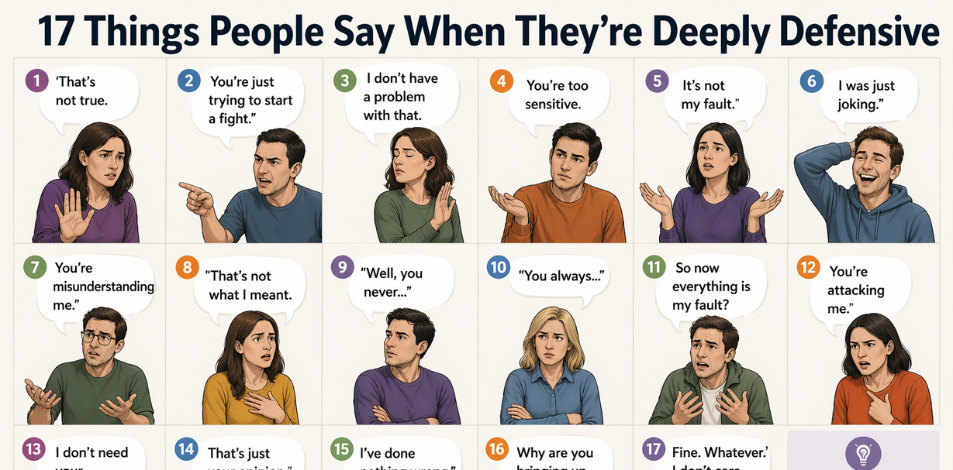
Self-defense often emerges when individuals feel threatened or vulnerable. It acts as a shield against perceived criticism, manifesting as words that deny responsibility and avoid addressing the core issue. This list explores 17 common phrases people use when they are highly defensive, offering insights into the psychological aspects behind these reactions.
- “That’s just how I am.”
Acknowledging one’s personality traits can be difficult. When someone says, “That’s just how I am,” it often means they are resisting change. This phrase may stem from a fear of vulnerability or an inability to contemplate personal growth.
This phrase creates a barrier, a way to end the conversation without delving into the details of the problem. By asserting their fixed nature, they avoid examining the underlying reasons for their behavior.
However, this phrase may also indicate a desire for acceptance. While denying responsibility, it implicitly asks others to accept them, flaws and all. In social interactions, this phrase leads to a dead end, hindering constructive dialogue.
- “You’re too sensitive.”
Describing someone as “too sensitive” minimizes their feelings. This is a classic defense mechanism used to deflect attention from the speaker’s own actions. By ignoring the other person’s emotional reaction, the speaker avoids self-reflection.
Related : 17 Alarming Signs of Disrespect in a Relationship and 17 Red Flags You Should Never Overlook
This suggests that the problem lies in the other person’s reaction, not the initial offense. This approach can lead the other person to question their own experiences, raising doubts about their emotional integrity.
However, underlying this dismissive comment may be insecurity. By projecting the problem onto someone else, the speaker avoids acknowledging their own potential fault. This often reveals discomfort with emotions and difficulty empathizing.
- “I don’t want to talk about this.”
Ending a conversation with “I don’t want to talk about this” signals retreat. It’s a defense mechanism used to avoid the discomfort of confrontation. This phrase halts the flow of communication and preserves personal comfort.
This often stems from a fear of confrontation or reopening painful topics. By refusing to engage in the discussion, the person maintains a sense of control over the situation, avoiding emotional outbursts.
However, it can also indicate exhaustion. When arguments become heated, some people find solace in silence. This phrase can serve as a temporary release, a pause to regain composure before addressing the issue at hand.
- “Why do you always exaggerate?”
When someone accuses another of exaggeration, they might say, “Why do you always exaggerate?” This phrase shifts blame and minimizes the problem, portraying the other person as overreacting.
By depicting the other as exaggerating, the speaker avoids taking responsibility for their own actions. It’s a way to escape guilt and downplay the issue.
This tactic can strain relationships because it minimizes genuine concerns. While this phrase acts as a shield for the speaker, it alienates the listener, who may feel unheard and ignored. It’s a defensive tactic that fuels division, not solves problems.
- “You’re misinterpreting me.”
Accusations of misinterpretation arise when someone feels cornered. Saying “You’re misinterpreting me” is a defensive reaction to a perceived misunderstanding. It’s a strategy to redirect the conversation away from the speaker’s original statement.
By insisting on misunderstanding, the person avoids accountability. This phrase shifts the focus to the listener’s understanding, rather than the speaker’s intention.
Despite its defensive nature, it underscores a fear of losing face. It’s an attempt to protect one’s image by denying responsibility. In conflicts, it can escalate tensions, as both sides cling to their positions, hindering reconciliation.
- “I didn’t mean it that way.”
The phrase “I didn’t mean it” acts as a shield against misunderstanding and is commonly used when someone feels their intentions have been misinterpreted.
By emphasizing the absence of malice, the speaker seeks to deflect criticism. This phrase implies that any offense stemmed from a misunderstanding, not intent.
However, this defense may lack sincerity. While it suggests a desire to clarify, it often avoids taking genuine responsibility. It’s an attempt to deflect blame for one’s words, which can make the affected party feel unappreciated.
- “I always think I’m the one at fault.”
Sarcasm is a common defensive tactic. Saying “I always think I’m the one at fault” uses sarcasm to avoid blame. It’s a way to express frustration while avoiding serious discussion.
This phrase often masks underlying resentment. By portraying themselves as perpetually the villain, the speaker seeks sympathy rather than a solution. It is a form of emotional manipulation, designed to provoke guilt in the other person.
While it may temporarily alleviate tension, it rarely yields fruitful results. Sarcasm can deepen disagreements and prevent honest communication. It also diverts attention from the problem, focusing instead on the perceived injustice of the accusation.
- “It’s not my fault.”
“It’s not my fault” is a classic way of shirking responsibility. It’s an automatic phrase intended to absolve the speaker of blame. This phrase may indicate a deep-seated fear of failure or condemnation.
By blaming others, the speaker avoids confronting their own role in the situation. It’s a way to maintain self-esteem by shifting criticism onto external factors.
However, this defense mechanism can hinder personal growth. It prevents self-reflection and the opportunity to learn from mistakes. In relationships, it can create friction because it ignores shared responsibility and understanding.
- “You’re overreacting.”
Saying “You’re overreacting” is meant to belittle the other person’s feelings. This phrase is often used to minimize the seriousness of a situation and shift the perceived problem onto the other person.
It dismisses genuine concerns as exaggerated, allowing the speaker to evade responsibility. This tactic can make the listener feel misunderstood and marginalized.
Using this phrase often reflects discomfort with strong emotions. It’s a defense mechanism to avoid delving into complex emotions. Instead of fostering understanding, it can create emotional distance, undermining trust and empathy.
- “I already apologized.”
Apologies can be complicated, especially when someone says, “I already apologized.” This phrase often indicates impatience with ongoing discussions about the issue at hand.
While an apology can be a step toward resolution, repeating it suggests defensiveness. It implies that the problem should be resolved simply by apologizing, without addressing the underlying issues.
This defensive stance can hinder progress. It ignores the need for genuine reconciliation and understanding. By insisting on a resolution, it disregards the other person’s ongoing pain, potentially leaving conflicts unresolved.
- “Let’s move on.”
The phrase “Let’s move on” is an attempt to end a conflict without reaching a resolution. It’s often used when someone feels uncomfortable with prolonged conflict or constant scrutiny.
This phrase seeks to bypass the effort required to address the issues, prioritizing superficial harmony over genuine understanding. It’s a defensive tactic that prioritizes quick closure over constructive dialogue.
While it may provide temporary peace, it often leaves underlying problems festering. In relationships and team dynamics, it can hinder long-term growth and trust. By avoiding the root cause of conflicts, it delays genuine resolution and healing.
- “You’re imagining things.”
Dismissing concerns with the phrase “You’re imagining things” is a classic psychological manipulation tactic. It undermines the other person’s reality and casts doubt on their perceptions.
This phrase is used to distract by making the listener question their own experiences. It’s a powerful defense mechanism that protects the speaker from accountability.
However, it can be extremely damaging to relationships. Denying the other person’s reality breeds distrust and emotional distance. This approach, while intended as a preventative measure, can lead to isolation and a breakdown in communication.
- “I can’t do anything right with you.”
Expressing defeat with the phrase “I can’t do anything right with you” is an overreactionary defensiveness. It shifts the focus from specific problems to a broader sense of inadequacy.
This phrase often stems from frustration and a desire to end the conflict with self-pity. It’s a way to elicit sympathy and deflect the conversation from responsibility.
While it may temporarily alleviate tension, it rarely addresses the core issue. In fact, it exacerbates resentment by placing the burden of resolution on the other party. It’s a defense mechanism that blocks the path to constructive dialogue.
- “I don’t see the point of this conversation.”
When someone says, “I don’t see the point of this conversation,” it often reflects a desire to avoid difficult discussions. It’s a defensive phrase used to downplay the importance of the topic at hand.
This phrase may indicate discomfort with confrontation or reluctance to face unpleasant truths. By questioning the value of the conversation, the speaker avoids addressing the core issue.
But this ignoring can be frustrating, as it downplays the other person’s concerns, potentially leading to feelings of neglect. It’s a tactic that hinders communication and leaves important issues unresolved.
- “You always bring this up at the wrong time.”
Complaining about timing by saying, “You always bring this up at the wrong time,” shifts the focus from the problem to the timing. It’s a defensive tactic to avoid the substance of the discussion.
Related : Jealousy in Love: 10 Times It’s a Sign of Affection and 10 Times It’s a Red Flag
This statement suggests that the speaker is more interested in avoiding the topic than addressing it. It’s a way to evade responsibility by focusing on perceived inconveniences.
However, this maneuver can backfire. By ignoring their timing, their concerns are completely disregarded. It’s a defense mechanism that prioritizes convenience over a solution and often leads to unresolved conflicts.
- “That’s not what I said.”
Replying to accusations with “That’s not what I said” is a defensive tactic used to correct perceived misunderstandings. It’s an attempt to redirect the conversation toward the listener’s precise understanding.
This statement may indicate a fear of being misunderstood and a need to clarify one’s intentions. By insisting on accuracy, the speaker is trying to avoid responsibility for unintended consequences.
However, this defensiveness can derail discussions, shifting the focus from the core issue to a verbal sparring match, often leading to frustration. It’s a tactic that hinders genuine understanding and problem-solving, focusing on words rather than meaning.
- “You’re making it too complicated.”
When someone insists on saying, “You’re making it too complicated,” they are trying to evade responsibility for the complications. This statement implies that the other person is unnecessarily complicating matters.
It’s a defensive stance that blames the listener for the difficulties. By accusing them of complicating the situation, the speaker avoids examining their own role.
While it may temporarily alleviate personal pressure, it often ignores legitimate concerns. This defensiveness can create tension because it suggests the other person is being obstructive. It’s a tactic that prioritizes personal comfort over cooperation and understanding.