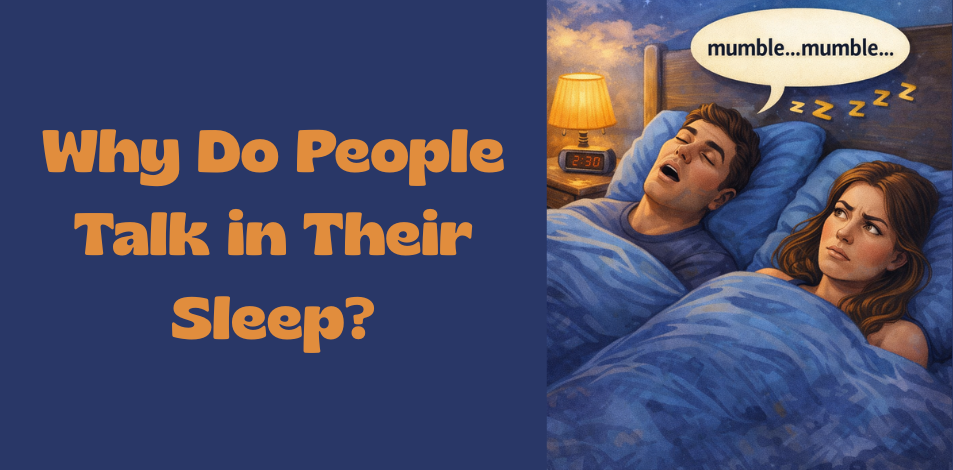
Why do people talk in their sleep? Do you or your partner experience this and wonder why it happens?
We’ve all heard the phrase, “You were talking in your sleep last night.” This can evoke a range of emotions, from surprise to embarrassment and even concern, but it always prompts the question, “What did you say?” The usual answer is, “Nothing interesting” or “Something incomprehensible.”
When and why do people talk in their sleep, according to science?
Studies have shown that sleep talking is often not a collection of coherent thoughts, but rather a series of short, disjointed words that make no sense at all.
According to the National Sleep Foundation (NSF) in the United States, sleep talking can occur at any stage of sleep. During rapid eye movement (REM) sleep, when dreams occur, it is usually a result of the dialogues we see in our dreams.
In practical terms, this means that the mouth and vocal cords, which are normally inactive during sleep, are temporarily activated and produce a sound that represents the words spoken by one of the “heroes” of our dream.
Sleep talking can occur during transitional phases, that is, when we move from one sleep stage to another.
In both cases, talking happens when something “interrupts” our sleep, prompting us to speak but preventing us from saying anything understandable to a listener.
It’s difficult to estimate how often sleep talking occurs because it happens during sleep, and if no one is waking us up, we may not even be aware of it.
However, studies have shown that more than half of children talk intermittently in their sleep, and this frequency decreases as they get older. Chronic sleep talking in adults is considered a sleep disorder and may be caused by stress and other factors.
Moreover, because sleep talking results from a temporary overlap between different stages of consciousness, it usually lasts for a very short time—just a few seconds, during which we utter a few words.
Nevertheless, there have been rare cases of someone having a full conversation while asleep. Even these cases are often disjointed, and while they may seem plausible, they shouldn’t be taken seriously.
For this reason, according to the U.S. National Science Foundation, sleep talking is not considered by science or law to be a reliable product of conscious or rational thought.