Have you ever walked away from a relationship feeling like you were no longer the person you used to be? Maybe you question yourself more than you ever did before. Maybe you feel emotionally exhausted, struggle to trust your own judgment, or find yourself apologizing even when you haven’t done anything wrong.
Sometimes, the damage caused by an unhealthy relationship doesn’t happen all at once. It happens slowly, through repeated criticism, emotional manipulation, broken promises, and moments that leave you wondering whether you’re the problem.
People with strong narcissistic traits may use these behaviors to maintain control, protect their self-image, or get their needs met at someone else’s expense. Not every difficult or selfish person is a narcissist, but certain relationship patterns can gradually wear down your emotional well-being.
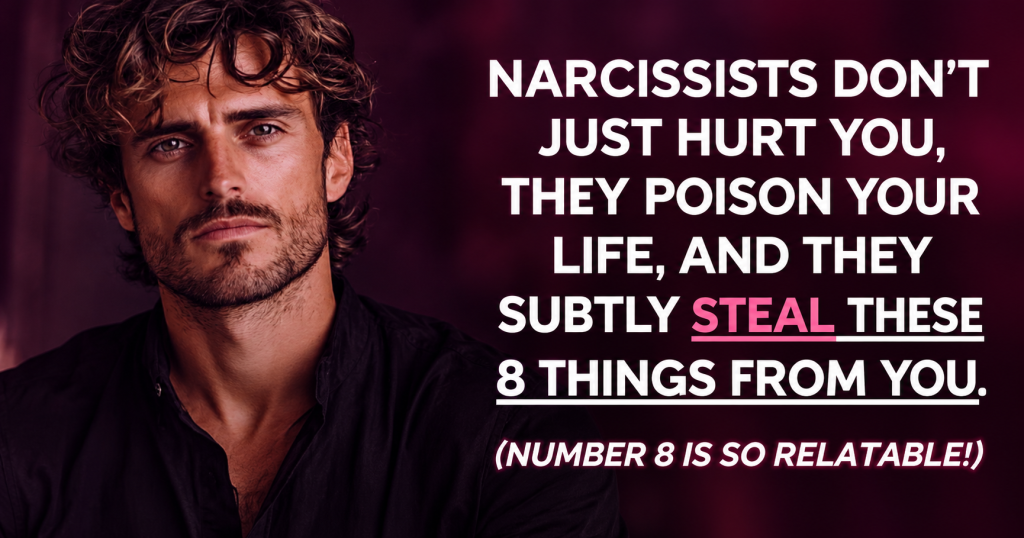
Here are eight things a narcissistic partner may gradually take from you without you even realizing it.
1. Your Self-Confidence
One of the first things you may notice is that you no longer feel as confident as you once did.
At the beginning, your partner might have made you feel special, attractive, intelligent, and deeply appreciated. Over time, however, the compliments may be replaced with criticism, comparisons, sarcasm, or comments that make you feel inadequate.
You might hear things like, “You’re too sensitive,” “Nobody else would put up with you,” or “You always get everything wrong.”
After hearing these messages repeatedly, you may begin to believe them.
You start questioning your appearance, your decisions, and even your worth as a person. Instead of trusting yourself, you begin looking to your partner for approval.
Related : The Dark Empath: When a Narcissist Can’t Control You
The truth is that you don’t have to become someone else’s version of perfect to deserve respect.
2. Your Peace of Mind
Living in a relationship filled with emotional uncertainty can leave you feeling constantly on edge.
You may find yourself analyzing every text message, carefully choosing your words, or trying to predict your partner’s mood before bringing up an important subject.
One day, everything seems fine. The next, a small disagreement turns into hours of silence, anger, or blame.
Eventually, you may spend more time trying to prevent conflict than actually enjoying your relationship.
This kind of ongoing emotional stress can affect your sleep, concentration, and ability to relax.
A healthy relationship doesn’t mean you’ll never disagree. It means you can express your feelings without constantly fearing punishment, humiliation, or retaliation.
Love should give you room to breathe, not leave you walking on eggshells.
3. Your Trust in Yourself
One of the most confusing experiences in an unhealthy relationship is beginning to doubt your own memories and perceptions.
For example, you remember a hurtful comment clearly, but your partner insists it never happened. You explain how something made you feel, only to be told that you’re imagining things or making a big deal out of nothing.
When this happens repeatedly, you may start asking yourself, “Did I misunderstand?” or “Am I being unreasonable?”
This can resemble gaslighting, a form of psychological manipulation in which someone repeatedly tries to undermine another person’s confidence in their own perceptions of reality.
Over time, you might rely on your partner to tell you what really happened, even when your original understanding was reasonable.
Rebuilding self-trust begins with giving yourself permission to acknowledge your experiences. You don’t have to agree with someone else’s version of events just to keep the peace.
4. Your Boundaries
At first, you may have clear limits about how you expect to be treated. You know what makes you uncomfortable, what you won’t tolerate, and what you need to feel respected.
But when those limits are repeatedly challenged, you may start making exceptions.
You forgive behavior that once felt unacceptable. You explain away disrespect. You say yes when you want to say no because you’re afraid of an argument or the emotional consequences of standing your ground.
Sometimes, your partner may respond to boundaries with guilt, anger, blame, or accusations that you’re selfish.
Eventually, protecting your own needs can start to feel like doing something wrong.
But boundaries are not punishments. They’re a way of protecting your time, energy, dignity, and emotional safety.
You are allowed to say no without writing a long explanation to justify it.
5. Your Identity
Perhaps you used to enjoy spending time with friends, pursuing your hobbies, dressing the way you liked, or working toward personal goals.
Then, little by little, those parts of your life began to disappear.
Maybe your partner constantly criticized your friends. Maybe they made you feel guilty for spending time alone or acted as though your interests were unimportant. Perhaps you became so focused on keeping the relationship stable that you stopped investing in yourself.
Without realizing it, your world became smaller.
You may even struggle to answer a simple question: “What makes me happy?”
This is one reason maintaining your individuality matters so much in a relationship. You can love someone deeply without giving up the things that make you who you are.
You are still allowed to have your own friendships, dreams, interests, opinions, and future.
6. Your Emotional Energy
Have you ever felt completely drained after a conversation that seemed relatively ordinary?
In an unhealthy relationship, simple issues can turn into exhausting cycles of arguing, defending yourself, explaining your intentions, and trying to prove that you never meant any harm.
You may spend hours thinking about what happened, wondering what you should have said differently, or preparing yourself for the next disagreement.
Meanwhile, your own needs keep getting pushed aside.
Over time, you might feel too exhausted to pursue your goals, enjoy your hobbies, or connect with people who genuinely care about you.
Not every difficult conversation is manipulation, and relationships naturally require effort. The problem arises when the emotional labor consistently falls on one person while the other refuses to take responsibility.
Your energy matters, too. You don’t have to solve every conflict alone or keep explaining yourself to someone who refuses to listen.
7. Your Connections With Other People
Another warning sign is when a partner repeatedly tries to interfere with your relationships outside the partnership.
They might criticize your family, create conflict with your friends, demand all your free time, or make you feel guilty whenever you seek support from someone else.
In some situations, they may tell different stories to different people, creating misunderstandings that leave you isolated.
The result can be a gradual loss of the support system you once depended on.
Isolation can make an unhealthy relationship harder to recognize because you have fewer opportunities to hear another perspective or receive practical help.
Healthy love doesn’t require you to abandon everyone else. A caring partner can respect your independence and understand that meaningful friendships and family connections are important.
If someone consistently pressures you to cut off people who support you, take that pattern seriously.
8. Your Ability to Recognize Your Own Worth
Perhaps the most painful change is when you begin to believe that the way you’re being treated is all you deserve.
You may remember how confident, hopeful, and independent you once felt. Now, you question whether you’re lovable, whether your needs are too much, or whether anyone else would treat you better.
You might stay because you believe that if you become more patient, more understanding, or less demanding, the relationship will finally become what you hoped it would be.
But you shouldn’t have to earn basic kindness by making yourself smaller.
Someone else’s inability or unwillingness to treat you with respect does not determine your value.
You can acknowledge your mistakes, work on yourself, and still recognize that you deserve honesty, consideration, and emotional safety.
Related : Why Narcissists Try to Destroy You
Your worth was never theirs to take away.
How to Protect Yourself From Narcissistic Manipulation
Recognizing unhealthy relationship patterns is an important first step, but understanding them is only part of the process. You also need to give yourself the time and space to rebuild.
Here are a few practical ways to start:
- Trust your observations. Pay attention to repeated behaviors rather than relying only on apologies or promises.
- Set clear boundaries. Decide which behaviors you will no longer accept and what you will do if those boundaries are crossed.
- Reconnect with supportive people. Spend time with friends, family members, or trusted individuals who respect your perspective.
- Keep a record when necessary. If you frequently find yourself confused about important conversations or events, private notes can help you remember what happened.
- Rebuild your independence. Make room for your interests, personal goals, financial well-being, and decisions.
- Consider professional support. A qualified therapist can help you process relationship experiences, rebuild self-trust, and develop healthier boundaries.
If you feel afraid of your partner or worry that setting boundaries could put you at risk, prioritize your safety and seek support before confronting them.
You don’t need to prove that someone is a narcissist to decide that a relationship is hurting you.
Final Thoughts: You Can Find Yourself Again
The effects of an unhealthy relationship can be difficult to recognize while you’re still trying to make it work. You may become so focused on understanding the other person’s behavior that you forget to ask yourself how the relationship is affecting you.
But healing begins when you turn some of that attention back toward yourself.
You can rebuild your confidence. You can learn to trust your judgment again. You can reconnect with the people and passions you lost touch with along the way.
Most importantly, you can stop measuring your worth by how someone else chooses to treat you.
You deserve a relationship where your feelings matter, your boundaries are respected, and your identity remains your own.
You are not broken because someone treated you badly. And you do not have to lose yourself to prove that you love someone.