Is there a true narcissist in your life, or just someone obsessed with themselves? Pay attention to these early signs of narcissism to help you tell the difference.
Everything revolves around them—what they want, how great they are, how much others envy them. The narcissist is the center of their own world and tries to make it the center of yours as well.
This behavior can be off-putting, making it difficult to be around or maintain a relationship with a narcissist.
But true narcissists—not just those obsessed with themselves—have a real, diagnosable condition called narcissistic personality disorder.
People with narcissistic personality disorder aren’t necessarily “bad” or “manipulative.” Many with this condition feel that their behavior is off-putting to others, but they don’t really know what they’re doing to elicit that reaction.
Try to show empathy, but also remember that you don’t have to stay in a toxic, abusive, or unfulfilling relationship.
If you suspect that someone in your life is a narcissist, paying attention to these early signs of narcissistic personality disorder will help you take your next steps.
What is a Narcissist?
A narcissist is someone who has a personality disorder called narcissistic personality disorder.
People with this disorder have an inflated sense of self-importance. They often feel they are important, even more important than others. They constantly seek attention, crave to be the center of everyone’s attention, and often place themselves above others.
Related : 7 Manipulative Phrases Most People Think Are Normal
But at its core, narcissistic personality disorder is characterized by a lack of empathy for others.
“A narcissist’s behavior ranges from an inflated sense of self-importance, arrogance, and entitlement to an almost childlike need for praise and admiration,” says Gina Moffa, a licensed clinical social worker.
This behavior can make it difficult to maintain healthy relationships. Narcissism is often seen as simply a “character flaw,” which increases the stigma surrounding the disorder.
It is, in fact, a diagnosable personality disorder and does not necessarily reflect a person’s values or choices.
Many people exhibit some symptoms of narcissism, but they do not necessarily meet the diagnostic criteria for narcissistic personality disorder.
A person needs to meet five of the nine criteria in the Diagnostic and Statistical Manual of Mental Disorders, Fifth Edition (DSM-5) to be clinically diagnosed with narcissistic personality disorder. These criteria include:
An inflated sense of self-importance; delusions of grandeur and unimaginable success; a belief that they are special and should only interact with those of high status; an excessive need for admiration; a sense of entitlement; exploiting others for personal gain; a lack of empathy; envy of others or the belief that others envy them; and arrogant and conceited behavior.
The diagnostic criteria require that these symptoms persist over time and manifest in most areas of life. These symptoms significantly impair a person’s ability to function in society.
Only mental health professionals are qualified to diagnose narcissistic personality disorder. While the diagnosis may be difficult initially, Mova says that the symptoms of narcissistic personality disorder become clearer during treatment.
Narcissistic personality disorder is often linked to a person’s upbringing. According to a reliable 2014 study, a person with narcissism is more likely to have been raised by parents who:
Believe their child is better than others
Mistreat them
Neglect them
How to Easily Spot a Narcissist
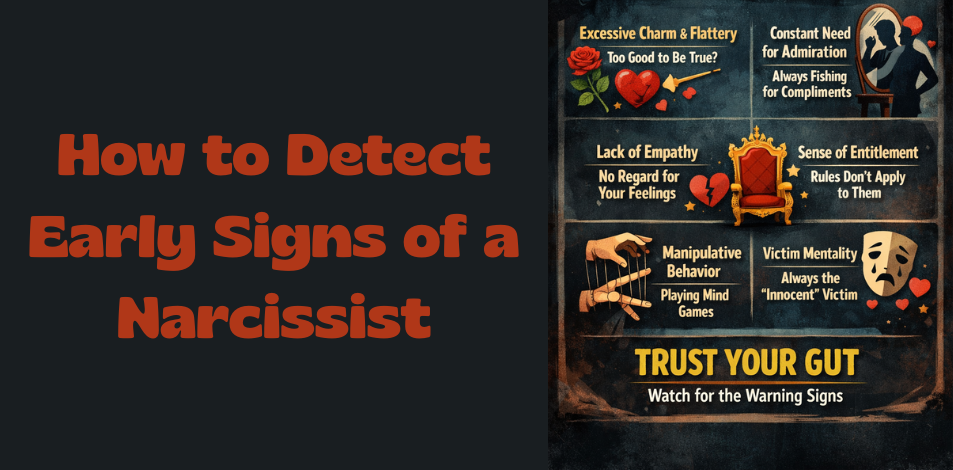
How can you tell the difference between a self-absorbed person and someone with narcissistic personality disorder? Many adults may exhibit some of these signs, but a narcissist with this disorder will display many more.
They talk about themselves a lot
If someone constantly talks about themselves—their life, their accomplishments, their superiority over others—and never asks about you or even gives you a chance to speak, pay attention.
They constantly seek praise
While a narcissist loves to tell everyone how great and important they are, they actually crave constant praise and may actively seek it out.
Moffa says, “At their core, narcissists are insecure and fragile people who desperately need love and admiration. They just need it more than the average person, but this need is real, all-encompassing, and harmful.”
They Make You Feel Treasure (At First)
If you start dating a narcissist, they may make you feel like the most admired and desired person in the world. But eventually, their interest will fade, leaving you feeling confused and rejected.
This behavior is called “love bombing,” and it often stems from a narcissist’s inability to form healthy relationships and their need to maintain control. People with narcissistic personality disorder often have an intense fear of abandonment.
Related : 8 Most Common Reasons Why People Forgive a Cheating Partner
Moffa says, “When you’re in a good relationship with a narcissist (meaning you’re fulfilling their constant need for attention and importance), they make you feel like you’re part of their world and shower you with attention. When you lose that relationship, they make you feel powerless and vulnerable, and you might feel like their anger is a weapon against you.”
They only give if it means getting something in return
Your needs always come second to the narcissist’s.
Because everything revolves around them, they’ll find ways to make your needs seem less important than their own. They might be skilled at manipulation, responding to one of your requests only to use it against you later.
They’re jealous of you and others.
In a 2020 study (reliable source), researchers asked current and former partners and family members of narcissists to describe them and their interactions with them.
Many participants noted that the narcissist in their life exhibited jealous behaviors toward others, as well as believing that others were jealous of them. One participant even mentioned that her husband, who has narcissistic personality disorder, was jealous of her relationship with their infant child.
If someone constantly talks about their looks and wealth and seems convinced that others are jealous of them, they may be a narcissist. This is often a result of deep-seated insecurity and a reliance on praise to bolster self-esteem—traits common to narcissistic personality disorder.
They are charming in public but quick to anger.
In addition to these negative traits, participants in the same study described their relatives and partners with narcissism as:
Charismatic
Fun-loving
Considerate of others in social situations.
While a narcissist may be charming to attract the attention they desperately need, Moffa says, “These behaviors can be manipulative and even abusive at times.”
This deep-seated vulnerability and constant fear of abandonment, which drives narcissists to fawn over others in public, also leads to their outbursts of anger, according to a reliable 2015 study. A literature review published in 2021 also indicates that narcissism may be a strong risk factor for aggressive and violent behavior.
Can a narcissist change?
You might wonder if someone with this condition can change. The answer is yes, there is hope for change through therapy.
“Although it’s difficult to admit to having narcissistic personality disorder, which is often viewed negatively, with the right therapeutic relationship—one that should be based on a stable and ongoing partnership—some of the self-sabotaging and self-destructive patterns of a narcissist can be overcome,” says Mova.
She adds that, through therapy, a person with narcissistic personality disorder can:
Heal old wounds related to family dynamics
Cope with painful emotions
Find ways to create more effective communication patterns
With consistent therapy over time, the symptoms of narcissistic personality disorder can improve. People with this disorder and those around them can look forward to more fulfilling and balanced relationships.