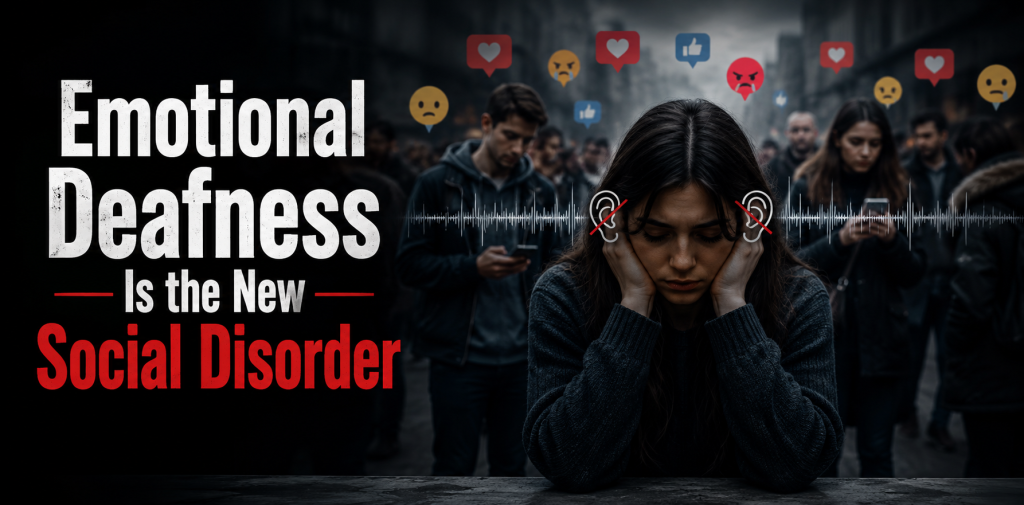
There’s a particular kind of silence that happens now when someone tells you something hard. You watch it happen at dinner tables, in group chats, in offices: a friend says “it’s been a really rough week,” and the reply comes back fast and flat , “ugh, same, anyway did you see this?” The feeling was heard the way a notification is heard. Registered. Dismissed. Moved past.
This isn’t rudeness in the old sense. Nobody meant harm. It’s something quieter and stranger , a kind of tone-deafness for other people’s inner weather. Call it what it is: emotional deafness. Not a clinical diagnosis, not a disorder in any medical sense, but a spreading social pattern that behaves like one , a collective dulling of the instinct to notice, sit with, and respond to what other people are actually feeling.
What It Looks Like
Emotional deafness doesn’t look like cruelty. It looks like distraction wearing the mask of engagement.
It’s the friend who says “that sounds hard” without changing their tone, their pace, or their face. It’s the coworker who responds to a colleague’s bad news with a solution before the sentence is finished. It’s the group chat that acknowledges grief with a single emoji and moves on within the minute. It’s the difficulty , real, physical difficulty , that so many people now report in simply staying in a room with someone else’s sadness without reaching for a phone, a joke, or an exit.
Related : 10 Years of Non-Monogamy: Lessons I Wish I’d Known Sooner
None of this is new as a human failing. What’s new is the scale, the speed, and the fact that it’s starting to feel normal.
Why Now
A few forces are converging to produce this.
Text ate tone. So much of daily connection now happens through typed words stripped of voice, face, and pause. Emoji and punctuation try to carry what a raised eyebrow or a cracked voice used to carry automatically, and they’re a poor substitute. People are getting less practice reading the small, unspoken signals that emotional attunement actually runs on , because so much of their communication no longer contains those signals at all.
Attention became the scarce resource. Conversations increasingly happen alongside something else , a second screen, a half-written message, a mental to-do list. Divided attention isn’t just distracted; it’s structurally incapable of picking up on subtlety. You can’t hear the catch in someone’s voice if part of you is somewhere else.
Compassion fatigue went mainstream. A feed that serves up tragedy, outrage, and other people’s suffering in an endless, undifferentiated scroll trains a kind of emotional callusing. When the war, the disaster, and the friend’s breakup all arrive in the same format at the same scroll speed, the nervous system starts treating them with the same weight , which is to say, not much weight at all.
Irony became armor. Vulnerability reads as unfashionable in spaces where detachment is the safer social bet. It’s easier, and often more rewarded, to meet someone’s rawness with a joke than to sit in it. Over time, that reflex stops being a defense and starts being the default setting.
Optimization culture reframed feelings as friction. In a world that prizes efficiency, someone else’s emotional need can start to register less as a person reaching out and more as an unscheduled interruption , something to manage, resolve, or redirect rather than witness.
Why It Matters
The cost of this isn’t abstract. Relationships quietly erode when people stop feeling heard, even if nobody can point to a specific slight. Workplaces lose trust when concerns get processed but not acknowledged. Families develop a strange fluency in talking near each other instead of to each other. And the people on the receiving end of emotional deafness tend not to complain loudly , they just stop bringing things up. The relationship doesn’t break; it thins.
Related : One Annoying Habit Exposes a Pseudo-Smart Person Right Away
There’s also a quieter cost to the people doing the not-hearing. Attunement is a skill, and like any skill, it atrophies with disuse. The less it’s practiced, the harder genuine connection becomes to access even when it’s wanted , which shows up later as a vague, hard-to-name loneliness in people who are, on paper, constantly in touch with others.
What Pushes Back Against It
None of this is fixed. Attunement is trainable, the same way it was learned in the first place.
- Single-task the conversation. Put the phone away, actually, not face-down-on-the-table away. Divided attention can’t do this work.
- Slow the response. The instinct to fix, redirect, or lighten a hard moment usually fires faster than the instinct to simply stay in it. Let a beat pass before responding.
- Name what you notice. “You sound tired when you say that” does more relational work than “that sounds hard,” because it shows you were actually watching, not just listening for a gap to speak into.
- Get comfortable with unresolved discomfort. Not every hard feeling someone brings you needs an answer. Sometimes the entire ask is be here while I feel this.
- Ration the feed. Constant exposure to undifferentiated suffering online makes it harder to feel the specific suffering of the person in front of you. Less scrolling, more margin.
None of this requires grand gestures. It mostly requires the same thing attention always required: choosing, again and again, to actually be where you are.
Emotional deafness isn’t a diagnosis anyone will find in a manual. But it’s a real and recognizable shape — one showing up in more rooms, more group chats, and more dinner tables than most people are willing to admit. The good news is that hearing, in this sense, was never really about the ears. It’s a habit. And habits can still be rebuilt.