The narcissist may be the one hurting you, but sometimes the people who stand by them can be just as harmful. The painful truth is that a narcissist’s family members aren’t always narcissists themselves. Some simply encourage the behavior, some protect the family image, and others have learned to remain loyal to the abuser.
Key Points
Not every relative of a narcissist is toxic, but some family members may encourage, protect, or participate in unhealthy dynamics.
The best approach is to watch for patterns, protect your personal information, and avoid trusting anyone just because they seem friendly. There are some dynamics within a narcissist’s family that you can’t immediately see.
Related : Never Trust These 6 People In The Narcissist’s Family No Matter How Nice They Seem
When you’re already emotionally exhausted, discovering that the person you confided in was passing that information on to the narcissist can be devastating.
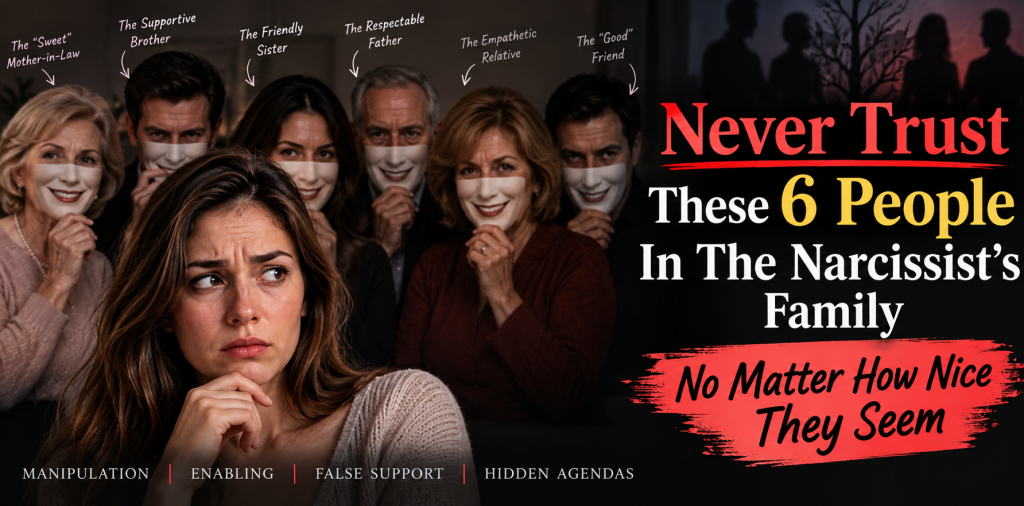
6 Narcissistic Family Members to Watch Out For
- Their narcissistic parent makes you feel uneasy about their behavior.
Sometimes, after meeting the parent of a narcissist, you’ll immediately recognize something familiar. Whether it’s a sense of entitlement, a desire to control the conversation, or an inability to take responsibility, it could be all of these.
This doesn’t necessarily mean the parent is the cause of everything observed in their adult child’s behavior. However, it’s important to remember that patterns of psychological manipulation and emotional abuse within the family may be deeply ingrained.
A narcissistic parent may fiercely defend their child, especially if they have given them a privileged position or designated them as the “spoiled child.”
- The Spoiled Sibling Draws You into Unwanted Competition
The spoiled sibling may seem charming upon first meeting them, even appearing cheerful, self-assured, and completely unconcerned with family problems.
But be wary, as this behavior can change when they attract attention, creating minor rivalries or attempting to dominate the situation. This is part of the dynamics of a narcissistic family.
A spoiled sibling may be used to receiving attention, having their wishes fulfilled, or being protected from consequences. This doesn’t mean that every spoiled sibling is toxic, but it does mean that you shouldn’t give them your trust without seeing how they actually behave.
- A “sulky” grandparent might exhibit similar behavioral patterns.
Older grandparents are often underestimated… You don’t need a diagnosis to see how they affect you. If you’re constantly leaving conversations feeling belittled, uncomfortable, or pressured to stay quiet, it’s a good sign to start creating distance.
- The narcissistic child knows exactly how much chaos they can create.
This might seem complicated, as it could be the child of a narcissist who has learned that lying, blaming, or creating problems gets them attention.
You might find yourself accused of something you didn’t do, then desperately trying to prove your innocence in front of everyone. So, if you’re experiencing this type of emotional abuse, your first responsibility is to stay safe and set appropriate boundaries. The goal isn’t to win an argument with someone who has already decided on the story they want others to believe.
- The abusive uncle or aunt knows exactly how to gather information.
The uncle or aunt might seem harmless because they aren’t the person you’re actually suffering from. That’s precisely why you might feel comfortable around them, explaining your perspective and telling them what happened.
Related : How To Stop Being Played By A Narcissist? The 9-Step Exit From A Narcissist’s Mind Games
You assume they’ll keep it between you, but somehow, the narcissist knows. In fact, some relatives may actively participate in narcissistic abuse by relaying information on their behalf or defending their harmful behavior to help maintain the family narrative.
- The brainwashed family member always takes their side.
This type of person can be one of the most frustrating to deal with because they may seem genuinely kind, listening to you, smiling, and saying they understand. But you’ll notice that as soon as you criticize the narcissist, they withdraw into themselves.
You may desperately want them to see what you see, but the truth is, they won’t because they’ve already chosen their position or are afraid of the consequences of challenging it.
How to protect yourself without getting drawn into their family problems?
Share information gradually and allow trust to grow through repeated evidence rather than immediately revealing your most sensitive experiences. Be cautious and observe what they do with other people’s secrets, because someone who constantly tells you about other people’s private matters may eventually betray yours. Keep your boundaries simple, and remember that you don’t need to give lengthy explanations when you decide not to discuss something personal. Stop trying to win them over, because if someone has already sided with the narcissist, repeatedly justifying yourself will only exhaust you. Finally, distance yourself when necessary, and if you feel uncomfortable or insecure, minimize your involvement instead of forcing yourself to stay close.