
A few years ago, I sat across from someone who told such a compelling story that I almost applauded him.
He had the chronology, the emotions, the moral high ground—everything.
Except for one thing: he corrected himself mid-sentence…twice. Not about something crucial, but about some random, insignificant detail. One of those details that doesn’t need correcting.
Then I realized: he wasn’t remembering—he was making it up.
That moment changed how I viewed people forever. Especially narcissists.
Because here’s the truth:
Narcissists aren’t just liars—they’re actors. And even the best performers falter under pressure.
They don’t lie the way ordinary people do. Their lies serve a deeper purpose—control, protecting their inflated egos, and, most importantly, maintaining their sense of superiority.
Related : Why Christmas Brings Out the Worst in Narcissists (And How They Ruin It for Everyone)
But here’s the good news:
Their need for control makes them predictable under pressure.
And if you know what to look for, you can uncover the flaw in their system.
The main idea:
Every narcissist has a telltale sign.
But it’s not the usual signs—not a nervous laugh, a tense stare, or a rigid scowl like we see in the movies.
No, narcissists make mistakes in more subtle psychological ways. Because their lie isn’t just a story; it’s part of their identity. And when that story is questioned, their brain does something interesting:
The brain immediately starts correcting mistakes.
Imagine a character in a video game who’s sluggish during combat. Outwardly, they look fine, but internally, they’re struggling.
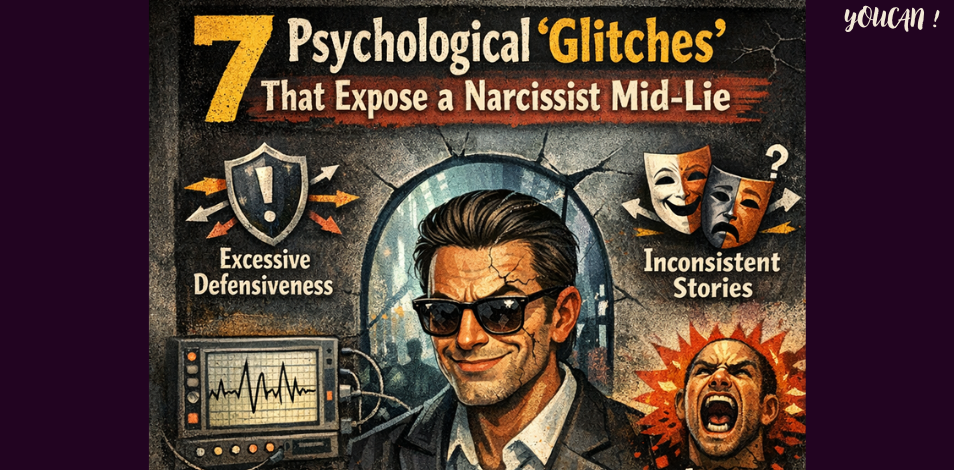
Let’s analyze seven psychological flaws that reveal them.
- Subtle Corrections: Their brains rush to correct mistakes.
You ask a simple question. They answer confidently.
Then suddenly:
“Oh, wait—no, I think it was Friday… Yes, Friday night, specifically.”
It sounds spontaneous. Innocent. Like a memory retrieval. But it isn’t.
It’s a mistake correction.
Narcissists edit their lies as they tell them. Not because they forget, but because they’re constantly searching for inconsistencies that might expose them.
They can’t stop editing because they’re trying to control your perception, not tell the truth.
Flaw: Over-correcting small details shouldn’t be taken seriously.
Remember: Real memories flow smoothly; fabricated memories require maintenance.
2. Reverse Guilt: They accuse you of exactly what they themselves do.
You bring up something suspicious.
Before you can finish your sentence, they interrupt, saying:
“You’re paranoid.”
“You’re always twisting things.”
“Are you accusing me of lying?”
A sudden digression. A sudden attack. No discussion.
This isn’t self-defense; it’s accurate projection.
Narcissists can’t stand a chance to strike back, so they quickly turn the tables on you. They accuse you of the very things you criticize in them. Why?
Because deflecting attention is the easiest way to avoid confrontation.
Flaw: Immediate and unwarranted accusations when questioned.
If they rush to blame before explaining, you’ve struck a nerve.
- Excessive, artificial calm: Their bodies go into “acting mode.”
Most liars fidget. Their hands tremble. Their voice falters. Their breathing becomes shallow.
But narcissists are different.
They know what guilt feels like and try to act the opposite.
Related : Why Narcissists Always Walk Ahead of You And What It Reveals About Their Mind
So they freeze. They breathe deeply and deliberately. They might smile calmly—like a seasoned actor playing the role of “innocence.”
But it doesn’t look natural.
It looks like a contrived performance.
Flaw: Their calmness seems artificial, not spontaneous.
Beware of seemingly perfect stillness.
When performance is smooth, the system is usually under stress.
- Rigidity in Narration: They Can’t Adapt Without Being Exposed
Try this experiment:
Ask them to retell the story, but spontaneously change the order of events.
“Oh, that was after you went to the bank, right?”
Observe what happens.
Most people pause, think, and then say, “Oh, yes, I think it was after that.”
But narcissists? They make mistakes.
Their expressions harden. Their words slow down. And they might explode: “No, I told you what actually happened.”
Why?
Because true memory is layered—you can change it, amplify it, or rearrange it.
But a lie?
A lie is like a Jenga tower. Change one piece, and the whole tower might collapse.
The mistake: Difficulty adapting to even small changes in the narrative or details.
Their rigidity stems from fear. They fear that even with minor alterations, the story won’t hold up.
- Self-serving justifications: Their lies serve their delusion of superiority.
Here’s something most people overlook:
Narcissists don’t lie simply to cover up; they lie to bolster their position.
It’s not just a matter of “I didn’t do it.”
The common refrain is:
“I didn’t cheat; people are very attracted to me.”
“I didn’t lie; you have no idea how smart I am.”
“I wasn’t fired; they were intimidated by me.”
Every lie has a bonus: self-aggrandizement.
The flaw: Their lies always make them look like heroes or victims, not perpetrators.
If they can’t tell a plausible lie, it’s not about the truth; it’s about maintaining their image.
- Overuse of the passive voice: “Mistakes were made…”
Pay close attention to their phrasing when they’re caught.
You won’t hear:
“I lied.”
“I did it.”
“I was wrong.”
You’ll hear:
“Mistakes were made.”
“They were questioned about it.”
“There was confusion.”
“There was a misunderstanding.” It’s classic linguistic ambiguity.
Related ; The Strange Habits Of Narcissists
No agent. No responsibility. No clarity.
Because for a narcissist, a mistake isn’t just an annoyance, it’s an existential threat.
So they completely deny themselves in the sentence.
Flaw: Vague, negative language when cornered.
When grammar masks guilt, watch out.
They’re evading responsibility with words.
- The Charming Surge: When cornered, they suddenly become more charming.
This is the strangest.
Most people become defensive when accused of lying.
But narcissists? Sometimes they become… charming.
They might laugh, soften their tone, compliment you, or joke to get out of a tight spot.
This isn’t because they’re comfortable.
It’s because they sense danger and are trying to win you over emotionally.
This isn’t logic; it’s emotional bribery.
They want you to feel good enough to doubt your instincts.
A glitch: A sudden burst of flattery, jokes, or displays of “charm” after being interrogated.
It’s a survival tactic. When the mask starts to crack, the smile widens.
Final thought:
Lying requires power.
But the moment you realize the flaw—the moment you notice the patching, the excessive engineering, the excessive calm—the lie loses its oxygen.
Here’s what I want you to understand:
A narcissist’s lie isn’t just in the words, but in the way they struggle to maintain the illusion.
And the harder they struggle, the more their true nature is revealed.
So, don’t look for the obvious.
Look for the exaggerated correctness.
Projection.
Rigidity.
Pride.
Word manipulation.
Unexpected charm.
Because the truth doesn’t need a shield.
A lie, especially a narcissist’s lie, always needs one.
Watch out for the shield.
It’s the first thing to break.
Want more ways to expose manipulation and keep your vision clear? Save this article or share it with someone who needs insight.
Let’s build a world where the truth doesn’t have to shout to be heard.