Do you know that moment when you wake up with your heart pounding, realizing you’ve been lying to yourself about a relationship for way too long? Yep, I’ve been there.
If you’re reading this, you’ve probably been there too, or you’re tired of watching someone you love shrink under the weight of self-destructive habits. Let’s be honest—no sugarcoating. Here’s the shocking truth about the toxic patterns we call “normal.”
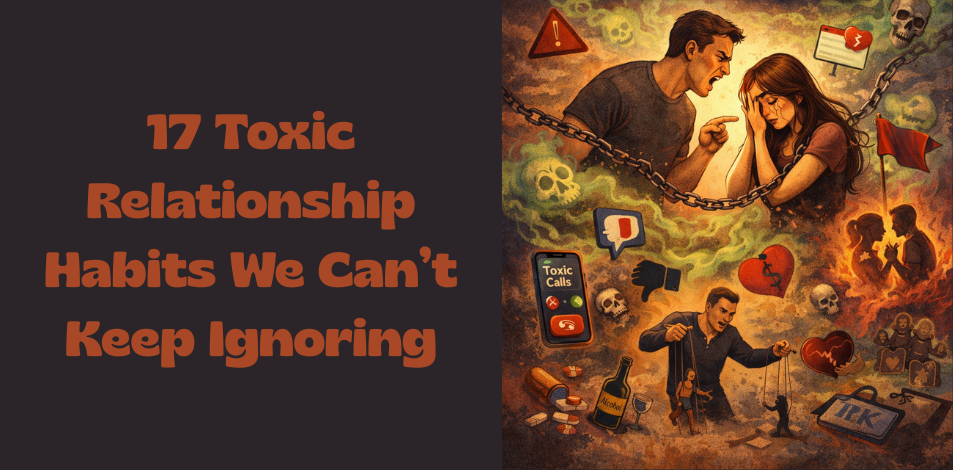
If any of these resonate with you, know that you’re not alone. We can’t heal what we don’t name. These are the 17 habits I wish we’d all stop making excuses for—because you and your heart deserve better.
- Psychological Manipulation: The Mind’s Labyrinth
Remember the first time you doubted your memory during an argument? Psychological manipulation isn’t just an internet buzzword—it’s a slow, insidious erosion of your self-confidence. One day you feel confident in what you see or feel. Then you find yourself apologizing for being “too sensitive.”
You spend hours replaying conversations in your mind, desperately trying to prove you’re not crazy. That’s what psychological manipulation does—it makes you question every reaction. When someone constantly rewrites your reality, you begin to doubt your sanity, little by little.
It’s more than lying or disagreeing. It’s subtle, calculated, and exhausting. You might start believing anything easier just to stop the argument. And the real pain? You lose confidence in yourself.
If this sounds familiar, remember—your memories and feelings aren’t made up. You’re not losing your mind—the situation makes you feel that way. That’s what makes it toxic. Don’t underestimate how deeply it affects you. Always trust your instincts.
- Constant Criticism: Silent Erosion
At first, it’s a sarcastic comment about your clothes or your laugh. Then it becomes about how you arrange the dishwasher, how you drive, even your dreams. Just as erosion carves a cliff, you appear solid, but pieces of you are constantly falling away. Living with someone who erodes your self-confidence until you barely recognize yourself. Every comment diminishes your best qualities. Criticism doesn’t improve you; it makes you anxious, like you’re walking on eggshells in your own home.
Related : 16 Signs You’re Carrying All The Emotional Weight In Your Relationship
Some call it “tough love,” but it’s not. True love supports growth and doesn’t demand perfection. The line between constructive criticism and hurtful scrutiny isn’t thin; it’s crystal clear.
You deserve someone who encourages you, not someone who makes you feel inadequate. Don’t let anyone convince you that you’re “too sensitive.”
- Controlling Behavior: Gradual Disappearance
Control creeps in quietly. It starts as a kind of concern—”Text me when you arrive” or “I just want to make sure you’re safe.” But you soon realize you can’t even breathe without permission.
You start justifying every minute you spend away from home. If you don’t, there will be arguments, accusations, and ignoring. It’s not protection; it’s possession. You start canceling plans, hiding details, and making up stories to avoid problems.
Losing your independence isn’t romantic; it’s suffocating. If someone loves you, they respect your freedom, not restrict your world. Control doesn’t always feel like handcuffs; sometimes it’s an invisible chain, and you only realize how tight it is when you try to break free. Trust those who trust you.
- Ignoring: Silence as a Weapon
Remember those arguments where the greatest pain wasn’t in the words, but in the silence? Ignoring isn’t a way to de-escalate the situation; it’s punishment. It’s a battle fought with absence, leaving you alone in emotional isolation.
You spend entire weekends staring at your phone, eager for a reply, replaying every word you said. Silence becomes torture when you’re prevented from speaking simply because you want to discuss things. It doesn’t heal; it exacerbates the situation, breeds resentment, and teaches you to suppress your feelings.
Constructive conflict can be painful, but it helps a relationship grow. This kind of silence is a major obstacle. When someone uses it to control or punish, it stifles the relationship. Your voice matters, even in the midst of a disagreement. Don’t settle for a love where you feel like you’re shouting into the void.
- Jealousy Disguised as Love: The Green Monster
Have you ever heard someone say, “I’m jealous because I care about you”? Jealousy masquerades as affection, but let’s call it what it is: it’s a source of fear. At first, it might feel like a compliment. Someone wants you all to themselves. Then it turns into suspicion, surveillance, and unfair accusations.
You start deleting contacts, hiding messages, and shrinking your world to avoid their questions. This isn’t flattery; it’s isolation. When someone uses love as a cover for control, they reduce your life to the size of their own insecurity.
True love celebrates your relationships, it doesn’t monitor them. If jealousy takes over your relationship, trust is lost. Don’t let anyone make you feel guilty or think possessiveness is a compliment. You don’t belong to anyone. You are a complete human being who deserves trust and freedom.
- Emotional Manipulation: The Strings of the Game
Have you ever apologized for something you didn’t do, just because it was easier? Emotional manipulation is a masterful art of inducing guilt. Those who use it distort your feelings until you lose confidence in yourself.
You apologize simply to keep the peace, even when you know you didn’t do anything wrong. This is how you begin to feel responsible for other people’s moods, worries, or anger. They play the victim, fabricate stories, and make you the one to blame.
This isn’t just drama; it’s exhausting. Manipulation looks like love, but it’s really an attempt to control. You don’t have to bear the burden of someone else’s emotional turmoil. Don’t let twisted logic convince you to compromise your boundaries. Your feelings are valid, even if someone denies them.
- Avoiding Difficult Conversations: The Slow Burnout
Have you ever felt like the air is heavy with unspoken words until you’re nearly suffocating? Avoiding difficult conversations is the slowest way to destroy any relationship. You convince yourself that ignoring problems will make them disappear, but it never works.
You avoid confronting the issues, pretending everything is fine. But the resentment doesn’t disappear; it only grows. One day, it explodes, and suddenly you find yourself arguing about something that happened six months ago.
Avoidance doesn’t protect anyone; it only postpones the pain. Difficult conversations often liberate you. If you can’t express what you want, you’re not in a partnership; you’re living with a stranger. Don’t sacrifice your needs for temporary peace.
- Carrying Grudges: The Hidden Burden
Carrying grudges in a relationship is like carrying a suitcase full of bricks. You try to move on while dragging emotional burdens you can’t seem to shake off. You might smile outwardly, but this burden never leaves you.
Related : 17 Ways to Recognize Toxic Relationships and Reclaim Your Emotional Well-Being
Every new argument reopens old wounds, until you find yourself arguing about everything and nothing at the same time. Those old wounds never heal; they only fester.
Forgiveness doesn’t mean forgetting; it means not letting the past destroy the present. If you can’t let go of the past, you’ll be stuck in it. Get rid of what’s disrupting your inner peace, or it will steal your joy, memory after memory.
- Ignoring Personal Boundaries: The Invisible Barrier
You feel like you’re suffocating because someone is constantly intruding on your personal space. This isn’t just rudeness; it’s relationship sabotage. It starts with reading your messages or ignoring your need for alone time. Soon, you lose your sense of privacy.
It appears everywhere: at work, at the gym, in therapy sessions. It sounds like loyalty, but it’s really a refusal to respect your independence. Boundaries aren’t walls that keep others away; they’re fences that protect the health of love.
You have the right to live a life outside your relationship. Your privacy, your time, and your body are non-negotiable. If someone keeps crossing your boundaries, they don’t love you; they’re draining you. Protect your personal space as if your happiness depends on it, because it does.
- Overuse of Technology: The Digital Divide
Have you ever sat next to someone you love and felt more alone than you ever did when you were alone? Overuse of technology creates a deep divide, not a bridge. When notifications interrupt every meal and every conversation competes with the screen, connection fades.
You start to feel invisible, like a secondary character in your relationship. It’s not the phone itself, but the message it sends: “There’s something more interesting out there than you.”
Technology isn’t the enemy, but it can become a wall if you let it. Love needs presence, not just physical proximity. Pay attention when your partner’s face turns blue rather than joyful at the sight of you. Make time for each other before the silence becomes louder than the sound of browsing the internet.
- Take notes: Record the relationship
Have you ever felt like you’re playing an endless game of “who owes whom?”? Keeping track of everything kills intimacy faster than any argument. Every favor, every mistake, every chore—it gets recorded, remembered, and pulled out like ammunition.
You find yourself replaying every insult, every flaw, every “I did this, so you have to do this and that…” statement. But love shouldn’t be a spreadsheet. If you’re tallying everything, you’re not loving; you’re running a competition.
Gratitude is lost when you keep track of favors. Love thrives on generosity, not debt. No one wins the blame game. In the end, both parties want to break up. Let go of the record. Love becomes lighter when you stop writing everything down.
- Walking on Eggshells: The Scary Stop
If you’ve ever carefully rehearsed your words until you can barely recognize your own voice, you know what it’s like to walk on eggshells. It’s exhausting, pretending to be less than you are so that someone doesn’t explode. You gradually lose yourself in their mood swings.
You learn to read the signs—tone of voice, body language, silence. You become someone who predicts storms instead of a partner. This isn’t love; it’s survival instinct.
You deserve a space where laughter is easier than apologies. If you’re always on edge, this isn’t a relationship; it’s captivity. Your inner peace should be just as important as theirs. Don’t compromise to fit into someone else’s comfort zone.
- Financial Manipulation: The Money Trap
Money can be the cruelest weapon in love. Financial manipulation isn’t always obvious. It’s not just about hiding pay; it includes demanding receipts, controlling your spending, or making you beg for necessities.
You can’t buy lunch or pay a bill without defending yourself. You don’t feel like a partner; you feel like you’re in prison.
Independence isn’t just about money; it’s about dreams. If you have to justify every expense, ask yourself: Is this love or possessiveness? No one should sacrifice their dignity for a meal. Protect your right to financial independence; your bank account is not a chain that restricts your freedom.
- Public Humiliation: The Open Wound
Have you ever wished the earth would open up and swallow you? Public humiliation is far more painful than any private argument. When your partner mocks, criticizes, or belittles you in front of others, the shame lingers long after the moment has passed.
You sit in a room full of people, and suddenly you feel exposed, insignificant, and humiliated because someone you love has used you as a target of ridicule. You pretend to smile, laugh, or act fine. But the pain isn’t just emotional; it’s relationship pain. Love is meant to be your sanctuary, not a stage for mockery.
Don’t let anyone convince you it’s a harmless joke. It’s not a joke if it hurts. Dignity matters, and love is never about putting yourself on display for attention. If you feel insecure or ignored in public because of your partner, this is a clear warning sign. Stand up for yourself, even if your voice trembles.
- Love Bombardment: An Overdose
Have you ever felt suffocated by someone who seemed too perfect to be true? Love bombardment is the flood of attention that sweeps you off your feet, then throws you off balance. It starts with grand gestures, endless compliments, and promises of eternal love before the sweets arrive.
Love bombardment isn’t an expression of genuine affection; it’s an attempt to get attention. Once you get attached, control begins, and the true character emerges.
If someone moves too quickly, showers you with love, and then turns to criticism or control, it’s not romance—it’s a trap. Healthy love grows slowly. Be wary of the overwhelming emotion that feels like a tidal wave. You deserve a stable relationship, not a draining one.
- Refusal to Take Account: The Blame Game
Have you ever felt like every argument ends with you being the one at fault, no matter what? Avoiding responsibility is a coward’s excuse. When someone always evades, denies, or blames you, any fair discussion becomes a losing battle.
Related : 4 Most Common Dreams and What They Mean According to Psychology
When your partner is unable to admit their mistakes, you feel invisible. Admitting fault isn’t weakness; it’s maturity. Refusing to admit fault teaches you to distrust your instincts.
A healthy relationship is a shared effort, not an exchange of accusations. If apologies are only coming from one side, find a way out. Growth occurs when both partners are willing to admit their mistakes. Don’t let pride or fear hold you back.
- Withholding Affection: The Cold Front
A feeling of coldness prevails when love becomes a bargaining chip. Withholding affection is a silent punishment that makes you crave a smile, a tender touch, or even a glance. Suddenly, the bed feels cold, and the silence is heavy.
Days go by without a hug, a kind word, or even a look. Affection becomes a reward, granted only for good behavior. This kind of love is conditional and leaves scars. You shouldn’t have to strive for warmth or connection.
Healthy love is given freely, not held hostage. If affection disappears every time there’s a disagreement, you’re not just being punished, you’re being taught a lesson. Don’t settle for crumbs when you deserve the whole cake. Your heart needs nourishment, not starvation.