What are the signs that you grew up in a toxic family? I grew up in a toxic family, but I thought it was normal. I didn’t realize how different my childhood was until I left home and started sharing my stories with friends and partners.
Often, the effects of growing up in a toxic family don’t become apparent until much later. You might struggle to maintain relationships, suffer from low self-esteem, or end up with a toxic partner.
Understanding the reasons behind our difficulties in adulthood can help us move beyond our toxic childhoods and live fulfilling lives.
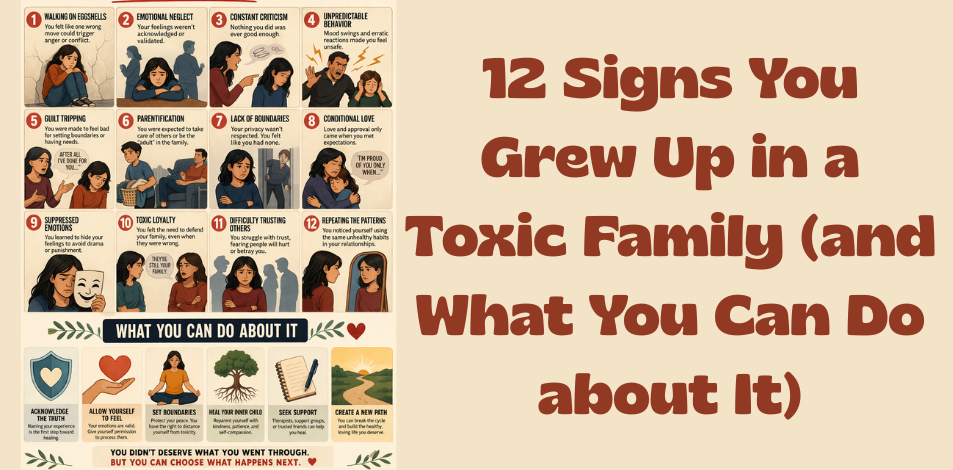
12 Signs You Grow Up in a Toxic Family
- You Were Mature for Your Age
Children who grow up in toxic families often take on significant responsibilities at a young age, which can cause them to mature faster.
This is how I remember my childhood. We walked half an hour to elementary school on our own; there were chores to do from a young age, evening jobs to pay the bills, and we lived under strict rules. I have few happy memories from my childhood.
- Did you have few friends as a child?
Were you the outcast who always wore mismatched clothes or ill-fitting shoes? Was your school uniform a patchwork of secondhand items? Did you ask permission before doing things your friends did automatically? Were you forbidden from going out and playing because of chores or homework?
Related : 15 Green Flags in a Relationship That Reveal You’ve Found The One
These are all signs that you grew up in a toxic family environment.
- You dislike eye contact.
Abusers use direct eye contact to intimidate or bully their victims. Victims learn to avoid looking away so as not to provoke a reaction or further abuse.
Research suggests that direct eye contact is threatening for adults who experienced PTSD in childhood because they associate it with violence. However, adults often perceive avoiding eye contact as a sign of anxiety or poor social skills, which can affect how they view you.
- You get angry for no reason.
Studies show that children remain attached to their abusive parents. However, there are serious repercussions later in life. Children who experience abuse, whether by witnessing it or by perpetrating it, still depend on these abusive parents for their safety and survival.
You feel terrified of the person who abuses you, yet you need them for protection. It’s a completely contradictory situation that can lead to confusion and anger as you get older.
- Difficulty forming healthy, long-term relationships
We learn about relationships from our parents. Their interactions shape our perception of ideal relationships. If there is mistrust, accusations of infidelity, or abuse in our parents’ relationship, it affects how we handle intimacy.
Difficulty maintaining long-term relationships is one of the signs that you grew up in a toxic family environment.
- You have a problem with food
Mealtimes can be stressful in a toxic family environment. Food may be scarce due to your parents’ neglect, or it may be used as a weapon to control you. You learned to eat as quickly as possible to escape anxiety or lack of food.
Now, food reminds you of stress, which manifests as eating disorders or a fear of eating in front of others.
- You are overly independent
If your parents were cold and unfeeling, you couldn’t ask them for help. You had to keep your problems bottled up, and you learned that the only person you could rely on was yourself.
Now, as an adult, you feel like a failure if you need someone’s help, because they instilled in you, as a child, the idea of self-reliance.
- You are overly dependent on others.
A parent who constantly reminds you how stupid and helpless you are fostering these same negative traits. Or perhaps your parents controlled every aspect of your life? You never learned how to be independent because they did everything for you.
- You need to justify everything.
Imagine growing up never knowing what would upset your parents. Even the simplest and most sensible things could trigger a barrage of abuse, catching you completely off guard.
So, to avoid such reactions in the future, you over-explain and justify your position or actions before things escalate.
- You don’t express your opinions/feelings.
Do people accuse you of being neutral? Have you been told that you’re withdrawn, cold, or unable to talk about emotional matters?
When you were young, you had to protect yourself from the chaos around you. Part of that involved suppressing your emotions. Perhaps your parents mocked or punished you for crying? You’ve come to see tantrums as a weakness, or you refuse to let others see you as vulnerable.
- You change yourself to please others
Living in a troubled environment or experiencing abuse in early childhood can affect your personality development.
If your parents ignored or bullied you, you may feel that your needs and opinions don’t matter. You might want to fit in or avoid being noticed. People may think you’re dishonest or inauthentic because you constantly change your mind.
- You feel responsible for other people’s feelings
When your parents hold you responsible for every problem at home, they’re holding you accountable for things beyond your control. You become overly cautious, expecting the worst and anticipating blame. You’ve made yourself emotionally responsible for everyone’s feelings.
Related : 8 Big Signs You Can’t Trust Your Partner
Holding children responsible for their emotions places an unnatural burden on them, which can last a lifetime if left unaddressed.
What can you do if you grew up in a toxic family?
If you notice any of the above signs that indicate you grew up in a toxic family, here are three things you can do:
Talk to your siblings
Do you have brothers or sisters who experienced the same toxic family environment you did? Are they willing to talk about their experiences? Talking to people who understand what you’ve been through can be helpful.
Keep your distance
If you want to maintain some kind of relationship with your toxic family members, you can refuse to get drawn into their family problems. You can do this by remaining impartial, maintaining a friendly dialogue, or changing the subject.
Reduce contact
There’s no rule in life that requires you to maintain contact with your family members. It might be better for your mental health to reduce this contact. It’s up to you to set firm boundaries or cut off contact altogether.
Conclusion
You can’t control the type of childhood you have, but by recognizing the signs that you grew up in a toxic family, you can define what you want for your future and heal along the way.